I had a friend who couldn’t stand being treated. Buy him a meal and he would insist on the coffee next time; if he couldn’t, he grew visibly restless. It wasn’t that he disliked owing a favor — he couldn’t bear the ledger not balancing. A man who had to settle before he could sleep. People like that, as a rule, can’t hold a grudge for long either. Hit them and they hit back on the spot, and once they’ve hit back, that’s the end of it. There are people who bank their resentments like deposits, and people who settle on the spot and zero out the balance. The latter seem to take the loss, but in fact they never get caught by their own resentment.
There is one such person in Evangelion. In a work where a sane character is harder to find than a broken one, a rare boy whose accounts are clear. Toji Suzuhara. He strikes Shinji with his fist, apologizes of his own accord a little later, and with that closes the account. A man who cannot hold his resentment for long. This is a story about that short shelf life.
The Power of Not Hating Long — Nietzsche
Toji’s first way of dealing with Shinji is violence. Learning that his little sister was hurt in the fallout of Shinji’s first battle, he calls Shinji out and hits him. But the thing worth watching in that scene is not the fact of the blow — it is how quickly the resentment ends. A little later, having seen what Shinji endured in the cockpit, he is the one who apologizes first. The interval from hatred to reconciliation is short.
In On the Genealogy of Morals Nietzsche divides two kinds of people. One banks resentment like a savings account: the person who knows how to keep silent, how to forget nothing, how to wait. His soul squints; his spirit loves hiding-places and back doors. The other is the person in whom resentment, even when it appears, is at once discharged in the reaction that follows. Of this second kind Nietzsche wrote that being unable to take one’s enemies, one’s mishaps, even one’s misdeeds seriously for long is the sign of a strong, full nature with an overflow of the power to shape, to heal, and to forget. His example was Mirabeau, who had no memory for the insults and slights done to him, and who could not forgive because he had already forgotten. Nietzsche adds one more line: if there is ever such a thing as love of one’s enemy on this earth, it is possible only in such a person.
The short interval between Toji’s fist and his apology sits on that sentence. He cannot bank resentment. Whether struck or striking, he settles on the spot and empties the balance. That he later extends his hand first to the very person who saved his life is less generosity than the simple fact that he has no vessel to hold a grudge in for long. By Nietzsche’s lights this is not weakness but an overflow of strength.
But there is a place Nietzsche barely speaks of. He assigned this power to the noble. The overflowing vitality, the forgetting that comes of a ruler’s ease. And Toji is no aristocrat. He is a boy who nurses his sick sister in his father’s stead, and who walks into a place where he stakes his life because of the hospital bills. If the very virtue Nietzsche called an overflow of strength can also come from the opposite place — a place with nothing — then its cause must be asked again. The one who takes that question is a physician in Hamgyong Province.
Remorse You Can Pay — Freud
When Toji comes to hit Shinji, he says something odd. Hit me — a clean line drawn under his own wrong. Freud left a note that fits this line. He said the word remorse should be reserved for the reaction after an act of aggression has actually been carried out, and that remorse is itself a punishment and can include the need for punishment. Guilt, he wrote, can even be older than conscience.
Toji’s guilt is of the payable kind. His sister was hurt; the cause, in his head, was Shinji; so he strikes, and then, having seen Shinji’s fear, revises. His guilt runs on a ledger too. Wrong committed, punishment demanded, balance closed. It is a guilt that resolves — it has an exit.
Freud, in the same essay, points to the other pole. Once the super-ego is installed, the difference between an aggression intended and one carried out loses its force; guilt can then be produced by a violent act merely intended, never done. That guilt has no exit. It cannot be paid, because there is no deed to draw the line under. Toji is the whole distance from that. His accounts run only on deeds — a blow given, a blow received — and deeds can be settled. This is the payable economy, and it is exactly the economy that another boy in this story never had access to. I leave him for the last seat.
A Bowl Held Out Without a Bill — Buddhism
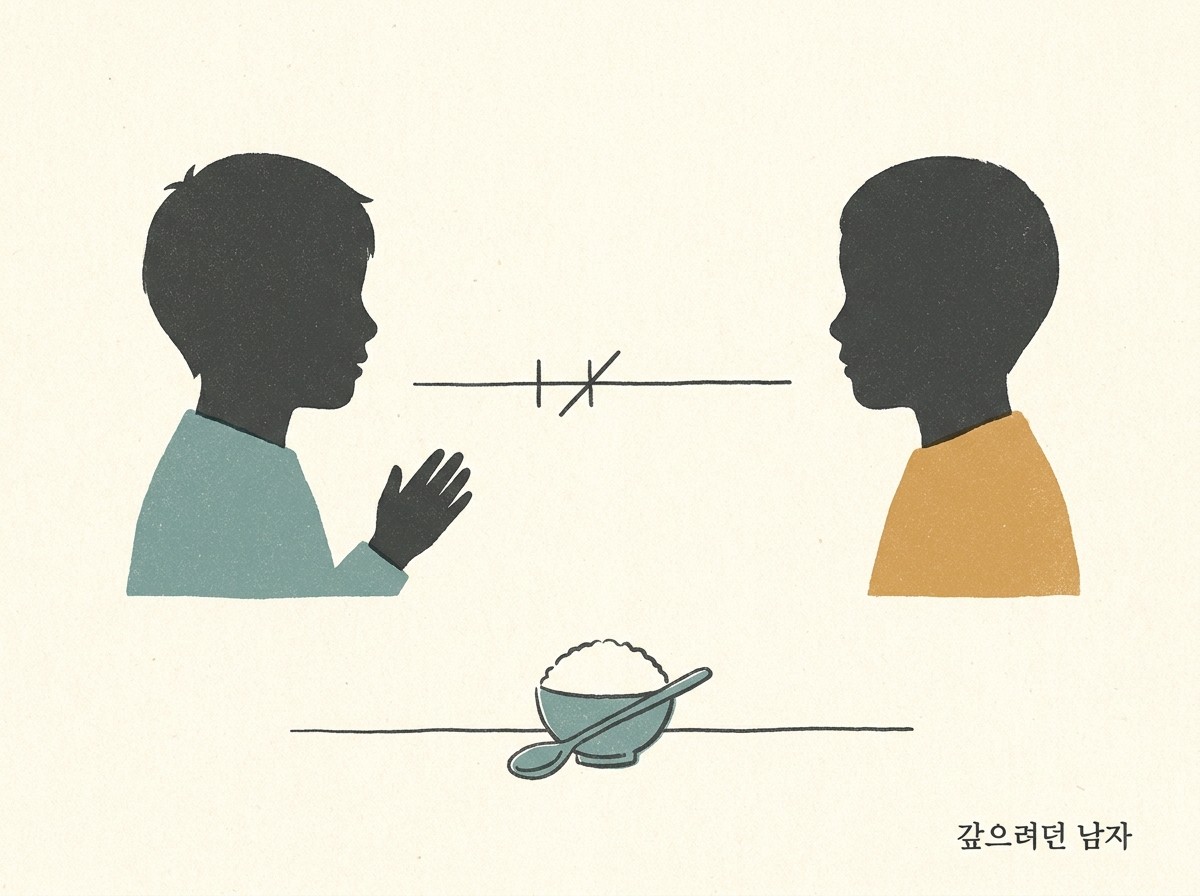
In the Rebuild films, years later, Toji lives in Village-3, a settlement of survivors, working as its doctor. Shinji, mute and curled in a corner, refuses even the porridge Toji has made. Toji does not press the account. He sets the bowl down and lets it be. He asks for nothing in return, presents no bill.
The fourth section of the Diamond Sutra sets down what is called the practice that dwells nowhere. A bodhisattva, it says, should give while dwelling in nothing — not dwelling in form, not in sound, smell, taste, or any dharma. Give without dwelling, and the merit cannot be measured. A gift that keeps no account. The whole of Toji had run on accounts: a blow returned, a debt repaid, a balance zeroed. And here, at the end, the man of the ledger sets down a bowl that keeps no account. He has not stopped settling because he learned a doctrine. It is that in front of a boy who cannot pay him back, and has no deed to be settled, there is nothing left to enter in the book.
The Sitting Where One Isn’t Reckless — Yi Je-ma
In Yi Je-ma’s 格致藁, Gyeokchigo, there is an admonition named for the trigram 艮, gan, and in it a curious list. The poor man’s heart, being poor, is not reckless; the lowly man’s heart, being lowly, is not arrogant. And then the other pole: the reckless man’s heart, being rich, grows more reckless; the arrogant man’s heart, being noble, grows more arrogant. The same disposition swings one way in a low place and the opposite way in a high one. Whether a person runs loose or holds steady is decided less by the person than by the sitting he is set in.
Here the reading crosses Nietzsche’s and reverses it. Nietzsche traced the power of not hating long to the overflow of the noble — vitality with room to spare, the forgetting of one who has plenty. Yi Je-ma reaches the same result from the opposite end. The poor man, being poor, is not reckless; the diligent man, being diligent, is not reckless. It is not surplus that holds a person steady but the lowness of the seat. Toji is not Mirabeau. He is the diligent man of the low place — the one who nurses his sister and stakes his life for the bills. The virtue Nietzsche granted only to aristocrats, Yi Je-ma returns to the man on flat ground.
Yi Je-ma adds a line that turns the reversal into a warning. Under heaven, he wrote, the diligent man’s body is not struck — recklessness strikes itself; the reckless man’s body strikes itself while the diligent man gains his diligence. The seat does the work. Set in the reckless place, a person amplifies into arrogance and self-aggrandizement; set low, he is not sold to it. Read against the rest of this series, the sentence has a mate. Where Gendo is the reckless man whom power amplified until it turned on him, Toji is the diligent man of the low seat, whom the same power passed by. The one place could not hold; the other did not need to.
But this reading, too, catches at the last. Yi Je-ma’s admonition ends in rest — knowing enough and knowing when to stop, coming to rest in the settled dwelling. Toji reaches that rest in the Rebuild films: a doctor in a village, a wife, a child, a bowl of porridge set down. And yet the rest was not something the seat guaranteed. The economy that let him settle every account had, once, no purchase at all.
The Account That Could Not Be Closed
There is a point where the settling economy stops. In the third Rebuild film, Toji is broken inside Unit-03, run on a dummy plug — killed, in effect, by Unit-01 under someone else’s command. What broke him there was not a person he could pay back. It was 勢, the force of the structure. A loss with no one on the other side of it. And in front of a loss with no counterparty, the ledger goes void. There is no one to strike, no debt to enter, no balance to zero. The man who settled everything meets, once, the one thing that cannot be settled.
This is neither his fault nor his failure. His whole strength was the payable economy — the ability to close every account on the spot. That strength has one blind side: it works only where there is a counterparty. Where the other side of the ledger is a structure and not a face, the book itself becomes meaningless. And it is exactly there, on the voided book, that the bowl of porridge in the Rebuild films is set down. Not a repayment. A gift that dwells nowhere, held out over a ledger that can no longer be balanced.
Which is why I read this boy against the woman I wrote of before. They stand at the same seat — the wide, mixed field where others’ pull and provocation come at a person. She held her resentment there, and the largest hatred stayed as the hardest solidity. He let his slip on the spot, and the account came out at zero. Same seat, opposite settlement. What decided it was not the person but what each did with the ledger the seat handed them: one kept it open, one closed it.
I still think of the friend who couldn’t stand being treated. There is a strength in settling on the spot and emptying the balance — no resentment banked, nothing carried. But that strength holds only where a counterparty exists. Some losses have no one on the other side, and in front of those the ledger goes void, and the person is left holding an unsettled account he did not open and cannot close. What Toji does then is the thing his whole economy could not prescribe: he stops keeping the book, and sets down a bowl. To hold something out without a bill, over an account that will never balance — that, perhaps, is the one payment that isn’t a payment.