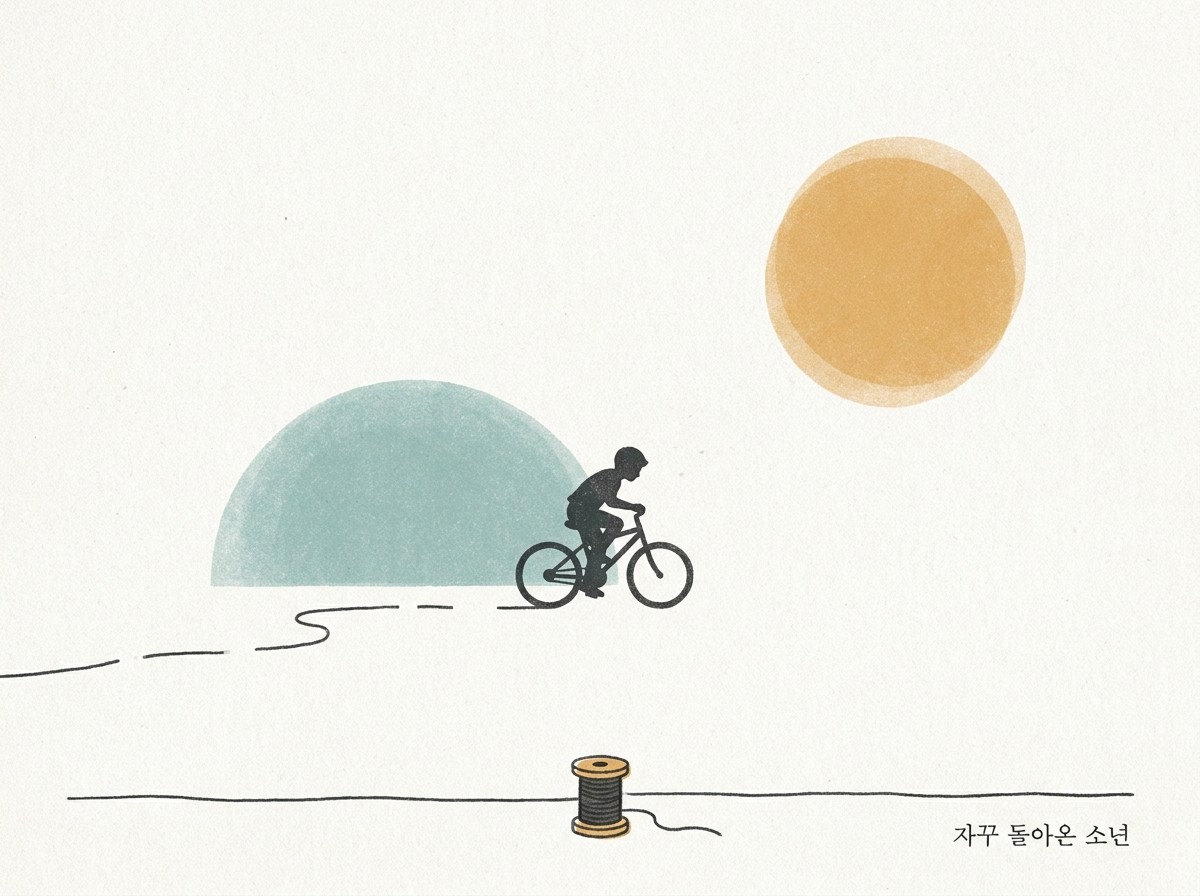
On a Sunday afternoon I spent a long while watching a child learn to ride a bicycle in the park. The training wheels had come off not long before, by the look of it. The child would go five or six metres, fall, get up, brush off his trousers, and climb back on. The adult beside him was strangely hands-off. No steadying, no lifting — just walking half a step behind, at the same speed. Count the falls and that afternoon is a record of failure; count the climbings-back-on and it is a record of practice. The same afternoon is entered differently in two ledgers.
On the way home I kept thinking of that child. For the better part of two months I have been reading the people of Evangelion, one by one. Twelve of them. One person remains. The boy who touched all twelve. The person who falls more than anyone in this story — and, if you switch ledgers, the person who climbs back on more times than anyone. Shinji Ikari. Muttering that he mustn’t run away, he ran away, came back, ran away again, and came back again.
The Shadow That Fell on the Ego — Freud
Better to start with this boy’s refrain. Someone like me. What’s the use, it’s me. He is the person who boards the largest weapon in the world, and in pricing himself he always sells low. In an essay written after long looking at people sick with loss, Freud noted one odd thing about self-accusation of this kind: listen patiently to a patient’s violent self-reproaches and you cannot avoid the impression that they scarcely apply to the patient himself — that with small changes they fit someone else, someone he loves, has loved, or ought to love.
the self-reproaches are reproaches against a loved object which have been shifted away from it on to the patient's own ego
Self-reproach is reproach meant for a loved object that has moved house and settled on one’s own ego. Then comes the famous sentence.
Thus the shadow of the object fell upon the ego
The shadow of the object fell upon the ego. Lay Shinji’s ledger over that line and the sums come out. His mother vanished before his eyes when he was small; his father abandoned him, summoned him, abandoned him again. The words owed to the one who left and the one who discarded — why did you leave me — have nowhere to go, and reproach with nowhere to go falls on the ego. Someone like me is a sentence manufactured that way.
Freud has one more text that fits this boy. He once watched his eighteen-month-old grandson play with a wooden reel. The child would throw it over the edge of his curtained cot with a drawn-out o-o-o-o, then pull it back by the string and greet its reappearance with a delighted da — there! Disappearance and return: that was the whole game. Freud’s reading was this: the child had had to let his mother go away without protesting, and he compensated himself by staging, with the objects in his reach, the disappearance and the return.
he was overpowered by the experience; but, by repeating it, unpleasurable though it was, as a game, he took on an active part
What was suffered is turned, by one’s own repeated hand, into something done. Shinji’s way with the Eva is that reel-game. Inside the machine is his vanished mother. Boarding is da; running away is o-o-o-o. What happened to him alone he tries to turn, by boarding and leaving over and over, into a game of his own hand. The four films run the game at the scale of a world: the same boy, at the same place, again. Only, the child’s game had an end. A reel comes back when you pull. Shinji’s reel has no string. Pull, and the mother does not return, and so the game will not end. This text explains why the repetition happens; how it stops is not written in it.
Becoming One’s Own Self — Jung
Jung would have begun at the end of the repetition. Of all the words he used in a lifetime, the plainest is individuation. In place of a grand definition he allowed this translation:
We could therefore translate individuation as 'coming to selfhood' or 'self-realization.'
Becoming one’s own self. What Shinji does in the last chapter of the last film reads like a diagram of that work. He meets them one at a time and talks. With his father, with Asuka, with Kaworu, and with Rei. One by one he takes back what he had hung on each of them — approval, salvation, his mother’s face — and says goodbye. Only where what was hung on others has been reclaimed is there a self left over. And among Jung’s sentences there is an unexpected one:
the process of individuation must lead to more intense and broader collective relationships and not to isolation
Individuation must lead not to isolation but to wider, denser relationship. If becoming oneself meant turning one’s back on the world, it would not be individuation. That is why the last scene is not a mountain temple or a desert island but a commuter railway station. Only, Jung’s map has a destination drawn on it. A whole that embraces conscious and unconscious — he adds the caveat that it is a never-ending approximation, and still he marks a point on the map to aim at. The physician from Hamgyong Province erases even the point.
The Preface of a Man Who Kept Losing — Yi Je-ma
There is a preface attached to Yi Je-ma’s book of admonitions, his 格致藁, Gyeokchigo. Having written out the admonitions of the eight trigrams, he asks himself why the book is called Returning to Sincerity, and answers: from youth to old age, think a thousand, ten thousand times as he might, the deceiving mind was without end; acted on, it ended each time in disgrace; the more cornered, the more bent, until, having no other way, he returned to sincerity and warned himself. And even returned, he could not be free of deceit — recovering again and losing again, 屢復屢失, he came to self-admonition. Then he adds a line. This year I am fifty-seven, and still I have not unlearned the habit, so I warn myself more and more — how difficult a thing deceit is.
A strange sentence for a fifty-seven-year-old physician to set in the preface of his own book. For two months I seated eleven people in the grid of these eight admonitions — and before one more, took down a blank — and all the while I handled the grid as a finished diagnostic instrument. Go back to the preface, though, and the man who built the grid did not write from the finished seat. He wrote from the seat of one who keeps losing. The admonitions are not the sermon of someone who arrived; they are the self-warnings of someone still falling.
Shinji falls more than anyone in this story. He runs, returns, runs again. The four films run that repetition at the scale of a world; the same boy starts over at the same place. You can read the repetition as a record of failure. Many did, and grew tired. But count it in Yi Je-ma’s ledger and the numbers change. He called it learning — the deceiving mind arising, and one’s turning back before acting on it. Not completion: the short interval between arising and returning is the whole of the study. Then losing again and again is not evidence of disqualification; it is the definition of this study. One who never loses has nothing to return from. Kaworu completed it in a single stroke, and for that reason was never this book’s reader. The book is addressed to people like Shinji. And the first reader, whose signature is on the first page, was a fifty-seven-year-old physician in Hamgyong Province.
Beside the preface stands a closing line. Having laid out the eight admonitions, Yi Je-ma gathers them into one sentence: the eight trigrams are all mind — 八卦皆心也. For two months I seated eleven people in eight cells. The father clutching what he lost, the guardian holding against the pull, the friend who went alone and accomplished. Seen from the closing line, though, the eight cells never belonged to the eleven. They are the eight aspects one mind takes at eight surfaces of contact — and in this story there is exactly one person who took all eight of those surfaces on his own skin. The father’s clutching, the guardian’s holding, the friend’s going alone: all of it happened across from him. Eleven essays’ worth of trigrams, and one blank frame, were in the end an album of one boy’s mind photographed in eight seats.
Here Jung and Yi Je-ma part. Jung’s individuation also has no end, but at the far side of the endless road a point called wholeness is marked. Yi Je-ma’s preface has no point. Only the confession that at fifty-seven he still keeps losing. Instead he moves completion elsewhere: the short interval between the arising and the turning back — that, each time, whole, is completion. Recount Shinji’s four films in this ledger, and they are not a list of failures but a list of returns.
The Raft You Don’t Carry — Buddhism
One question remains. If returning is the study, what is the Eva? What carried him this far is, in the end, that machine. It was the one place he met his mother, the one reason his father called him, the one way he proved his use. In the Agamas there is a story of a man who crossed a river. Having bound grass and wood into a raft and crossed safely, he thinks: this raft has served me well; now I will carry it on my shoulder, or on my head. The Buddha asks: is that the right use of a raft? It is not. Leave it in the water, or on the bank, and go. And he closes: even the dharma must be relinquished — how much more what is not the dharma.
Shinji’s last choice is that hand on the bank. He does not smash the Eva or curse it. Keeping what was owed to it as gratitude, he rewrites the story toward a world that no longer needs it. Saying goodbye as he does. Not to carry on your head the thing that carried you across — that, the old sutra says, is the courtesy owed to the boat.
Allowed to Fall
The station stairs of the final scene I wrote of once, in the essay on Mari: the hand that took off the collar came from outside the eight cells. Now it is time to write the side that received the hand. The neck the collar came off belongs to the mind that touched all eight cells. The hand from outside the grid and the mind that passed through all of it take the stairs at a run, hand in hand, and the picture turns from drawing to live action. A trigram is a diagnosis, not a fate — I know no picture that draws that sentence more exactly than this scene.
I think of the child in the park again. Some day that child will ride. But to ride does not mean to stop falling. It means to go far, allowed to fall, no longer counting the falls. The adult walking half a step behind knew that, I think, and kept his hands off. And the fifty-seven-year-old physician who wrote how difficult a thing deceit is in his preface, and still bound the book — that, too, was probably the same knowledge.
I close the thirteenth essay. If two months of changing lenses taught me anything, it is that a person does not end at being seated in a cell. The cell only lights the seat he stands in today; tomorrow he stands in another. Losing again, and again coming back.