When a person dies, their things remain. But the things do not all remain with the same weight. The belongings of someone you loved well and let go can be sorted, even through tears. You fold the clothes, keep a few pieces, send the rest away. The ones that cannot be sorted belong to a different category: the belongings of someone you hated to the end. Your hand will not reach to throw them out; kept, they scrape at you every time you see them. Love knows how to finish; hatred does not. The unfinished feeling clings to the object, and the object goes on living in the house in the person’s place.
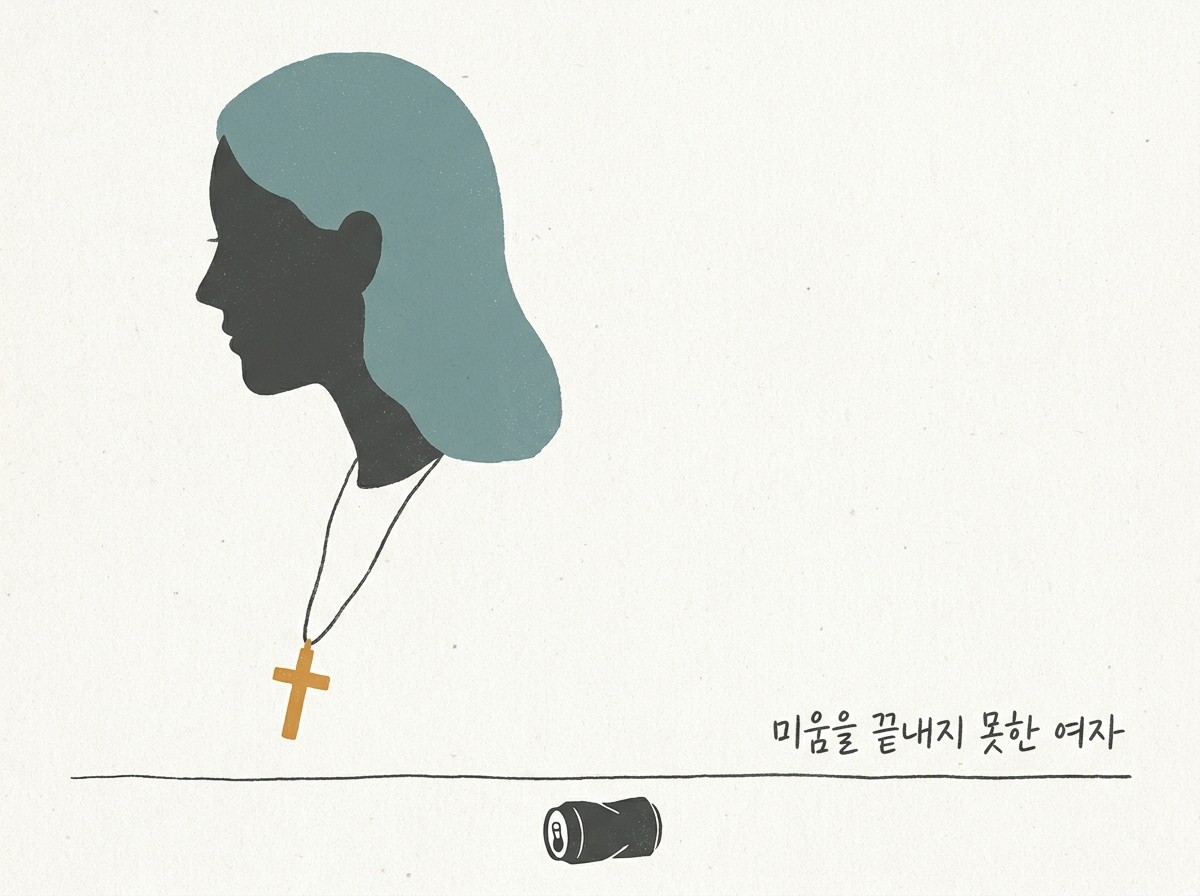
Misato Katsuragi of Evangelion did not merely keep such an object in her house — she wore it around her neck. A cross pendant her father left behind. She says plainly that she hated him: a man lost to his research, who never once looked back at his family. And yet that hated father, in his last moment, saved his daughter with his own life, and the daughter has not taken his keepsake off her body in more than a decade. To hate someone and to wear him. I have come to think this one necklace is very nearly the whole of this character.
The Man Who Protected Her — Freud
Freud once gave a rather dry answer to the question of whom we come to love. In the fourteenth volume of the Standard Edition, in the paper on narcissism, he names the two prototypes of love: the woman who feeds him, and the man who protects him. The loves we find as adults, he says, are a procession of substitutes stepping into those original places. It is an unromantic sentence, and for Misato it is frighteningly exact. Her father is the man who protected her — in the most extreme way possible. On the day the world broke in half, he put his own body outside the capsule and his daughter inside it. When the man you hated becomes the man who saved you with his life, the hatred loses its destination. The girl did not speak for the next two years.
What Freud saw in his paper on mourning is precisely this hatred with nowhere to go. To lose someone you loved is grief; to lose someone you loved and hated at once is not grief but deadlock. He wrote that the loss of a love-object is an excellent opportunity for the ambivalence hidden in the love to make itself effective. The one at whom the hatred was aimed is gone, so the hatred loses its bearing — folding inward, or changing shape and continuing somewhere else. Misato’s two years of silence at fourteen looked, from outside, like mere muteness; inside, this deadlock must have been turning.
Her speech came back, but the lost words seem to have continued elsewhere. At university she met Ryoji Kaji and fell in love — and one day, realizing what that love actually was, she ran. Later she says it in her own words: she had loved a man like her father. And that had terrified her. Freud would not have been surprised. As he saw it, what a person cannot work through, they do not remember — they repeat it, live it out. What fails to become the past keeps returning as the present. Misato’s life reads like a diagram of that sentence. She fled a man like her father; her fleeing feet carried her into the organization that spends its existence pursuing the very event in which her father died; and there she met Kaji again. She ran from her father three times and arrived, all three times, in front of him.
The Dark Sun — Jung
Jung looks at the same place from a different angle. In a late book of his there appears the phrase the dark sun of feminine psychology. Deep in a daughter’s mind there is a dark luminary that tints her entire image of men, and its first carrier is the father. Which men a daughter will be drawn to, which men she will not be able to bear — the father sets the zero point of that scale. What Misato discovered in Kaji, and recoiled from, was exactly this zero point. She thought she had chosen him; the hand that chose had been tuned long before.
Where Jung parts from Freud is in what follows. He looked for the way out of that tuning in the removal of a mask. What he called the persona — the face we wear toward the world — originally meant the mask worn by ancient actors, and the danger, he said, lies not in the mask itself but in coming to believe the mask is one’s own face. Misato is a person whose mask is unusually well made. Outside, she is a quick-deciding, subordinate-charming, capable commander; a cheerful woman like the older sister next door. Inside the door that face closes behind her, the apartment is a ruin of beer cans and instant-food containers. A knack for making whoever is in front of you feel good circulating on the surface, and a slide into one’s own comfort the moment one is alone — if you lay this, just as an exercise, on the grid that Yi Je-ma’s (이제마, the nineteenth-century Korean physician-thinker) successors use for reading temperament, the knack and the slide are not two separate things but the front and back of one person. We see her mask come off exactly once: in front of the last voice message Kaji leaves her, a face that is neither the commander nor the neighborly older sister collapses and weeps. Jung, I suspect, would have counted that moment as the closest she ever came to her own face.
A Net, a Glue — Buddhism
Buddhism adds one more name to this repetition. In a sutra of the Saṃyukta Āgama, the Buddha speaks of craving as if pouring out words: it becomes a net, becomes glue, becomes a spring, becomes a lotus root. And because of it, beings go from this world to that world and come from that world to this world — wandering back and forth without a moment’s rest. What Freud called repetition, this old text calls coming-and-going. So long as the thirst remains, one returns to the same well.
The Dhammapada has a shorter sentence still: from love comes sorrow, from love comes fear. The fear that made Misato run from Kaji was, then, not the opposite of her love but its exact shadow. The Buddha’s prescription is to cut the net of craving. Misato lived inside the net instead — filling the refrigerator with beer, filling the apartment with noise, pouring one thirst over another. Glue does not dissolve that way.
Lured, But Not Sold — Yi Je-ma
Set out this far, the picture seems to close: the story of a mind tuned to a father, circling the same spot. But there is one item on her résumé that does not fit inside this picture. The organization called NERV. Why she went to that organization, the four books explain. But why did that organization take her? The sole survivor of Second Impact; a woman with a debt to collect from the Angels — from the organization’s point of view there is no fuel more certain or more cheaply had. She returned to the place where her father died, yes; but the place also called her. The hatred was hers; what burned it for motion was the organization’s machine.
In the Gyeokchigo (格致藁), in the set of admonitions called the Banseongjam, Yi Je-ma mapped the configurations that arise between people into eight positions, and among them is this one: the position in which others lure and draw you in. The sentence he left for that position reads: 雖則智黠 誘導不售 — however wise and quick you may be, before the lure, do not be sold. Cleverness, in other words, is no shield. The clever are the ones who get sold without knowing they are being sold. Misato was clever, and she was sold — to the bait called revenge. She named it a calling, and the organization did not correct her. One cannot tell a child placed in that position at fourteen that she should not have been sold. Nor does Yi Je-ma say to change the position itself. The position is given; not being sold within it is the only part that is yours — that is the grain of all eight of his positions.
In the same admonition there is a sentence that faces this one like a mirror: 導而又售 奚其爲導 — to lead, and then to sell what you lead — how is that leading? It is aimed at the person who once stood in the position of being sold and finds herself, at some point, standing in the position of the seller. Misato’s relation to Shinji sits exactly on this scale. She is his guardian: she gives him a home, feeds him, worries over him. She is also the commander who sends him into battle — and the battlefield is where her revenge is staked. The hand that leads and the hand that sends out are the same hand. The care for the boy and the use of the boy overlap in one body. Yi Je-ma wrote down the criterion that divides the overlap, too: 愛而不褻 是曰善愛 — to love without defiling: this is called loving well. Whether Misato passes that scale cannot be known until the last scene.
When the Cross Leaves Her Hand
That last scene. Shot and bleeding, Misato drags Shinji to an elevator, takes the cross from her neck and closes his hand around it, kisses him, says — that was an adult’s kiss; when you come back, we’ll do the rest — and lets the doors close. She knows she is not coming back. The promise is a lie. The scene has been argued over for decades: whether a dying guardian’s kiss to a fourteen-year-old boy is love or violation. Lay Yi Je-ma’s scale against it and the needle trembles at a precarious point.
But what I find myself watching is not the lips. It is the hands. In that moment she did not pull Shinji toward her. She pushed him out. Instead of drawing the boy into the coming-and-going she was caught in, she sent him outside it. And the object she had not been able to take off her body for more than a decade left her hand for the first time. Not because the hatred had ended. That kind of ending, I suspect, does not exist. The man who wrote the Gyeokchigo recorded of himself that at fifty-seven he still had not rid himself of the deceit in his own heart. There is no ending; there is only, each time, the stopping of one more turn. Misato stopped the last turn. The hatred did not end — but it did not cross over to the next person.
I began with the unsortable keepsake, so let me return there. I wrote that the belongings of someone you hated cannot be thrown away, but watching her I have revised the thought a little. Perhaps such things are sorted not by discarding but by handing over. A sorting in which the receiver does not receive the weight — in which it ends with the giver’s hand going empty. Misato never managed to throw it away, and at the end she handed it over. That empty hand is the only victory this woman ever won over her own repetition.