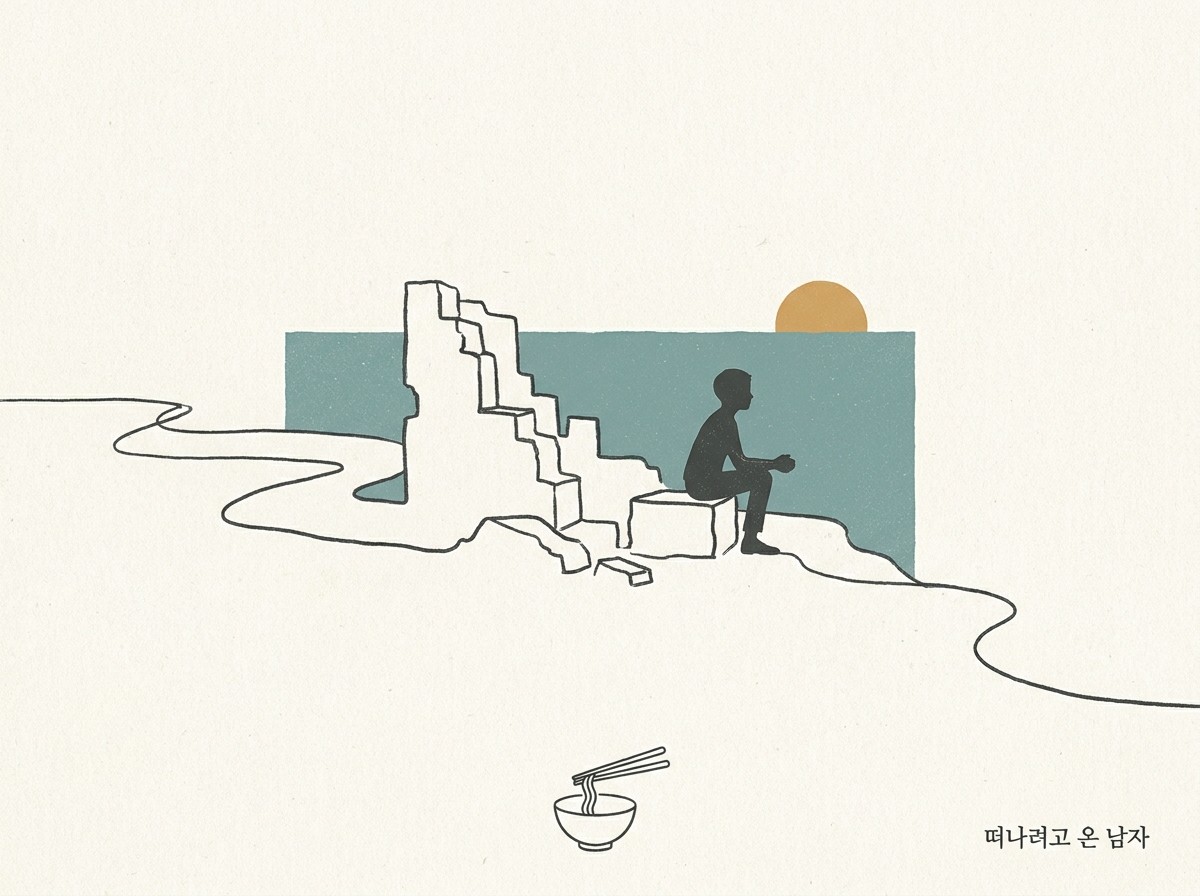
There used to be a Chinese restaurant near my home, the kind that had been there twenty years. Last spring it closed. I didn’t know it was the final day of business. I ate the black-bean noodles I always ate, paid the way I always paid, and left. Only days later, reading the notice taped to the shutter, did I learn that the bowl had been my last. I think about it now and then. If I had known, how would I have eaten it? More slowly? Would I have said something to the owner? Probably I would have managed nothing. To carry out an ending properly, knowing it is the ending, is harder than it sounds.
Most of our endings arrive this way — they become endings only afterward, retroactively. An ending performed in full knowledge that it is one is rare, and the rare kind we call a rite. But here is someone who arrived already knowing his own end. Who knew, on the day he came, the day he would leave, and who carried that knowledge as if it weighed nothing. Episode twenty-four of Neon Genesis Evangelion: a boy sitting among lakeside ruins, humming to himself. Kaworu Nagisa.
He arrives later than anyone in the story and leaves faster. His appearance amounts, in effect, to that single episode. And yet that single episode settles over the whole of the protagonist’s remaining life. Writing about Yui, I once called her the person who appears least and is present most. Kaworu is her symmetry. Yui vanished in order to stay; this boy came in order to leave.
Together, Never One — Jung
There is something strange about the way Kaworu comes to Shinji. On the day they meet, without condition, he puts his goodwill into words. No one in this story has done that for Shinji. Everyone ordered him, or made him endure, or hid something from him. Only Kaworu sits down beside him asking nothing.
In the ninth volume of Jung’s Collected Works there is an essay about the friend who appears to a man in crisis — Khidr, who came to Moses and led him through deeds beyond comprehension. Jung called this figure the inner friend of the soul: the larger, greater personality maturing within us, the thing nature herself would like to change us into, arriving in human form. And he annotated the figure. Born in darkness. The Long-lived One. Analogous to the Second Adam. Kaworu was born on the day of Second Impact, is not human, and carries the soul of Adam. It is one of those rare cases where Jung’s sentences read like a production bible written half a century early.
In the same essay Jung reaches for an older image: the Dioscuri — one brother mortal, the other immortal, always together and never able to become completely one. We are that pair, he writes. And he adds: whether the friend turns out to be friend or foe depends on ourselves. A fourteen-year-old mortal, and an immortal who asks to die by his hand. The whole configuration lies almost exactly over Jung’s sentences.
But there is a cold underside to Jung’s reading. The friend, in the end, is not another person. He is the image of something that had been growing within. If so, what Shinji met that day was not a strange boy but the self he might have become — the one who believes it is all right to be liked as you are. What that hand held, and what it let go, descends here one more layer.
I read Jung’s last sentence again. Friend or foe — it depends on ourselves. For Shinji the sentence arrives not as a choice but as a sequence. He meets Kaworu as friend, is informed he is foe, and kills him with his own hand. Friend and foe come not as two people but as two phases of one person — the darkest part of what Jung said about the inner friend is performed here, literally. That famous minute of stillness, Unit-01’s fist stopped in the air: perhaps it was the length of time a mortal held his own immortal in his grip.
To Die in One’s Own Fashion — Freud
In a year of war Freud wrote an essay on death. In it stands an odd observation: a person cannot imagine his own death. Try, and you find you are still there beside the scene — as a spectator. Hence, he concluded, in the unconscious every one of us is convinced of his own immortality. The being for whom death is certain cannot look at it, and that blindness is part of what holds a life up.
Kaworu is the mirror image of the observation. A being who need not die — the kind that would survive the end of mankind — looks at nothing but his own death, and looks at it straight on. There is no spectator’s seat. He stands inside the scene of his death as its only actor, calm as someone who has already watched the whole reel.
A few years later Freud went further. In Beyond the Pleasure Principle he proposed that every organism possesses its own path to death, and that the instincts of self-preservation are merely guards posted along that path, warding off every death but the one immanent in the organism itself. The organism wishes to die only in its own fashion. The guardians of life, he wrote, were originally the myrmidons of death.
Kaworu’s ending sits exactly on that sentence. His death was scheduled — by the scenario, by the organization, by what he was. What he changed was not whether, but how. Not execution at a stranger’s hands, but death at the hands of the one person he chose, for the reason he chose. His claim that to choose one’s own death is the only absolute freedom becomes, translated into Freud’s language, a statement about necessity. The same fact, and one side names it freedom, the other instinct. Which is right, I don’t know. But the distance between the two names looks very much like the distance this boy kept from being human.
The Third No-Self — Buddhism
This is the third time in this series I have brought out the word no-self — 無我, anātman. Reading Rei, I saw a lamp not yet lit: the flame called “I” that had never burned clearly, a dimness from before arising. Reading Yui, I saw the opposite shore — a person who stood distinct and then loosened her own place to become the ground under everyone, but who never closed; the paradox in which what Buddhism called compassion, Yi Je-ma answered was the deepest hardening. And at the end of the Rei essay I set down a sentence: if Rei is the beginning of no-self, then Kaworu, who comes later, is its end. The time has come to honor that sentence.
Kaworu is the first person in this story to call the wall a wall. The AT Field — known until then by its name as a weapon — he renames: the wall of the heart that everyone carries. The others were born inside the wall and treat it as air; only he, who came from outside it, sees it as a wall. Seeing is not demanding. He does not tell Shinji to take his wall down. He does not reach over it. He simply recognizes that the wall is there, and says he likes the boy — wall and all.
On friendship, the Saṃyukta Āgama records an exchange. Ānanda suggests that keeping good friends amounts to half the holy life; the Buddha tells him not to say so. Not half — the whole. Because I am the good friend of all beings, he says, and through me they are freed from birth, aging, sickness, and death. The good friend is not a companion on the path; the good friend is the path. For Shinji, Kaworu was exactly that — with the direction reversed. The Buddha’s friend pulls a person out of death. Kaworu is the friend who hands a person over by way of his own.
So the phrase “the end of no-self” must be used with care. He never preached no-self. What he did was two things. He left other people’s “I” unshaken. And at the last, standing where every wall could be dissolved — holding the key to that door — he closed only the membrane that was himself. The being sent as the perfected form of no-self chooses, at the end, to guard another’s self and withdraw his own. If Rei’s no-self was the not-yet-arrived, and Yui’s the never-closed, Kaworu’s is the self-closed. Beginning, unfinished, complete: the triangle closes here.
But as it closes, a question is left standing. Why did the perfected no-self fail to become this story’s answer? That question does not belong to Buddhism. It belongs to a physician at the end of the nineteenth century, in Hamgyong Province.
To Go Alone, Without Deceiving — Yi Je-ma
In Yi Je-ma’s 格致藁, Gyeokchigo, there are eight admonitions, and at their head stands the one named for the trigram 乾, geon. To go alone and achieve is not to deceive — 獨往能成不爲誑, to go alone and be able to achieve is to practice no deception. Where timing lies, examine the timing without fail; where power lies, the power; where position and profit lie, the same — and standing alone, the admonition ends, one does not fear. Yi Je-ma was not aiming at sages when he wrote this. He was aiming at ordinary people: the warning that wherever a person gains the strength to achieve something alone, he is set, without exception, in a current of deception. Know the current first, and watch it.
The place Kaworu was set down is exactly that place. He is a being designed as a deception. The organization sent him in wearing a pilot’s face; his mission itself was a disguise. Timing, power, position, profit — the position of a key that could open the end of the world — all of it lay in his hands. In that place he examined, and did not deceive. He hid nothing of himself from Shinji; before the last door he went down and confirmed with his own eyes; and having confirmed, he did not turn the key. He went alone, achieved, did not deceive, did not fear. He is the first figure in this series I have seen fill the four clauses of the admonition to the letter.
Yi Je-ma also kept a list of the ways a person hardens. The one who abandons propriety and runs loose; the one who abandons rightness and slips into ease; the one who abandons wisdom and dresses up his private ends; the one who abandons humaneness and drives his craving to the limit. All four harden by abandoning something — a trade in which one virtue is discarded to preserve the “I.” Kaworu stands outside the list. He abandoned nothing. If he discarded anything, it was the “I” itself. Into a world of people who discard a virtue to keep the self there came, once, a being who kept every virtue and laid the self down.
Writing about Yui, I once condensed into three the conditions Yi Je-ma attaches to a self-given death. That there be something clearly achieved. That every other path have truly been tried. And that it close in death. Yui lacked the third, and so the largest love remained as the hardest solidity. Kaworu meets all three. At a fork where only one side could live, the achievement was clear; he went down to the final door and confirmed that no other path existed — he had tried; and he closed it with death. Across this whole series he is the only one who fulfills, entire, the form the old Confucians honored: giving one’s body to complete the good.
And it is precisely that completeness that catches. At the head of the admonitions Yi Je-ma set down his own confession. From youth into old age, he wrote, the deceiving mind had been endless in him; returning again and again, losing again and again — 屢復屢失, nubok nusil — he had kept watch over himself, and at fifty-seven he still had not forgotten the impulse to deceive. What he called the human path is not a single leap but this endless returning. Only one who can fall can return; only one who can be deceived has something to watch. Admonitions are written for such people. Kaworu has none of that. He completed it once — first time, last time. That the completion was possible at all is the mark that he was never this admonition’s reader. He who has no configuration that can harden has no place to return to.
The Kaworu of the Rebuild films reads like corroboration. There he does not end in one stroke. He returns to the boy again and again, and again and again fails in the same place. The promise to make him happy ends, each time, in its opposite. Only when he has become the very shape in which Yi Je-ma summed up his fifty-seven years — returning again and again, losing again and again — does this being draw near the human form. Completion belongs to gods. Returning belongs to people.
The Answer Not Chosen
The sentence at the end of the Rei essay had a second half: the beginning of no-self and its end — neither, at the last, is chosen. Kaworu came as a finished answer, and the story does not choose the answer. In the place where every wall has melted, the boy feels sick, and raises the walls again. The completion was beautiful; what was chosen was the unfinished.
Let me also set down that this is neither his fault nor his failure. His completion was a form possible because he was not human. Take the form alone and imitate it from a human place, and what remains is not freedom — only death. What Yi Je-ma said of Yui’s place returns here with more weight: it is not to be taken as a path; imitated, it only hardens.
What he left was not the answer but something else. In front of Misato, Shinji says it through tears: Kaworu said he liked me. He was the first. A word he had heard from no one — not from his father, not from anyone. Not no-self, not freedom: that one word remained. The boy will carry it across the rest of his life — falling again and again, returning again and again. That story I leave for the last seat of this series.
I still walk past that Chinese restaurant. The shutter stays down; the notice has faded in the light until the letters blur. A last bowl eaten in the knowledge that it is the last — I am not someone who can do that, and I suspect most of us are not. We miss our endings, always, and we carry things out only by returning, again and again, to the place we missed. So I read the story of the boy who came knowing his end and closed it with his own hand — without envy. He did what we cannot do. We do what he could not: stumble, return, and begin again tomorrow in the same place. That shabby, interminable repetition is our share of freedom.