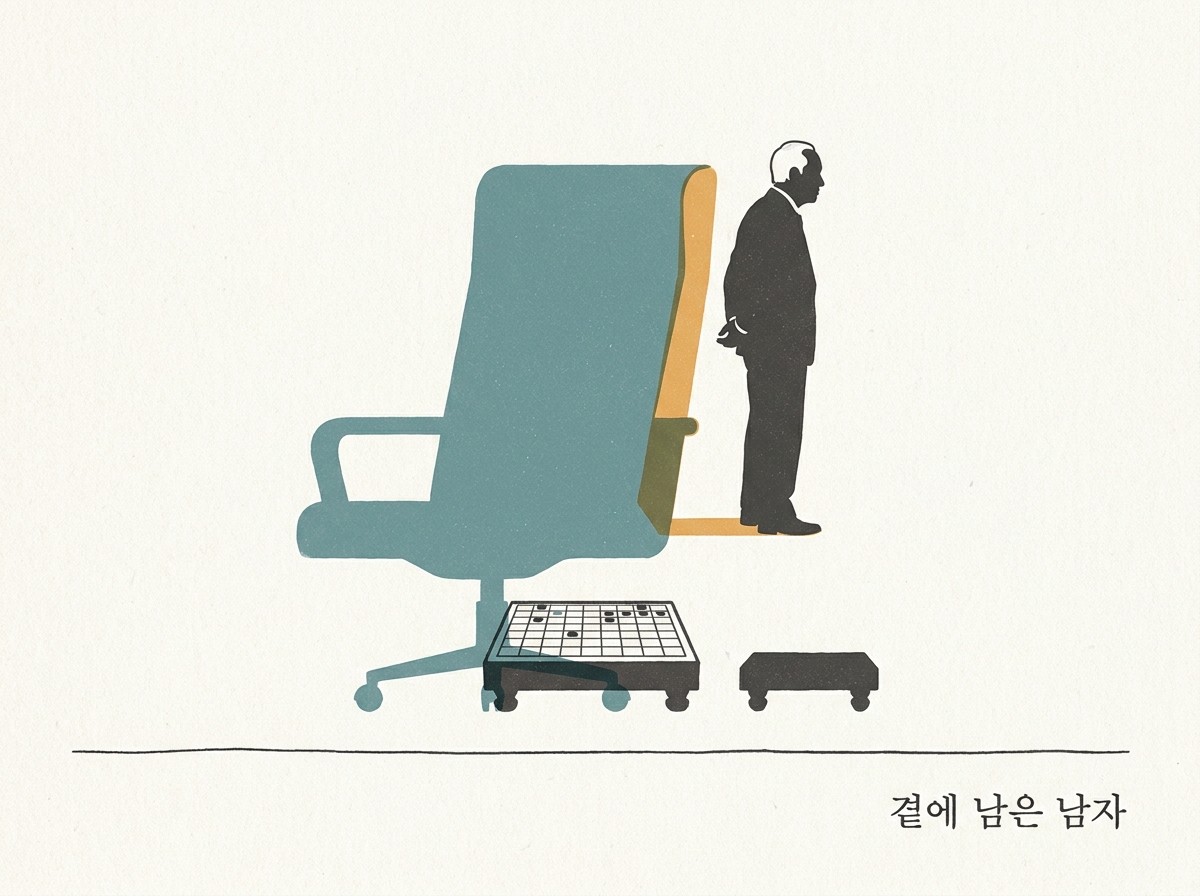
On a weekend afternoon I sometimes take out the janggi board — Korean chess — and play with my daughters. They know only half the rules, so the game usually dissolves somewhere in the middle, but I try to play mine to the end. Not for the sake of winning. There are moves that remain on the board after the mate has become visible — the few moves the losing side plays anyway, knowing — and I have come to think those few moves can sometimes explain the whole of a person. In Evangelion, the person who played those moves longest is not one of the children in the entry plugs. It is the old man at the second-in-command’s post, always one step above, hands clasped behind his back: Kozo Fuyutsuki. In Evangelion: 3.0, the third of the Rebuild films, he calls Shinji in, sets a shogi board between them, and informs him, quietly, that he will be mated in thirty-one moves. It sounds like a cruel sentence. I see something else in that scene: it is also the thing he has been saying to himself for more than a decade. He is a man who saw, earlier than anyone, that the game could not be won — and did not leave the board.
A Love That Never Took Aim — Freud
Nowhere does the story say that Fuyutsuki loved Yui Ikari. What we are given: that he was her adviser in the Kyoto years; his face on the day he heard she was marrying; and that in thirty years the way he addresses her — Yui-kun, the collegial form a professor uses for a student — never once changed. That is all. What would Freud have called this everything-that-is-not-anything? In the eighteenth volume of the Standard Edition he sets down an odd observation: the most lasting bonds between people are formed precisely by impulses inhibited in their aim. The reason is simple. They are not capable of complete satisfaction. A love that takes aim begins to wear out from the moment it arrives; a love that never took aim has no occasion to wear at all. A feeling that was never confessed and never refused is denied the very form of an ending. Fuyutsuki’s thirty years look less like devotion than like this mechanism.
In another paper Freud described a type of man in whom love ignites only where there is “an injured third party” — only for a woman who already belongs to someone else. Fuyutsuki stands at the opposite vertex of that triangle. He is the injured third party. Freud wrote the psychology of the man who takes; he did not write where the man who was pushed aside keeps the love afterward. Fuyutsuki shows us the storage method: you take a job beside the place where the person disappeared. After Yui was gone, every trace of her lay in one man’s hands — Unit-01, Rei, Shinji, the scenario entire. And so, instead of finishing the mourning and withdrawing his heart — the withdrawal Freud called mourning’s normal destination — he took the adjutant’s seat beside the traces. Gendo’s side was the closest place in the world to Yui.
There is an anecdote of Freud’s that belongs here. One summer before the war, he walked through the countryside with a young poet who could take no joy in the beauty around them, because it was fated to vanish. Does transience discount value? Freud answered the other way: a flower that blossoms for a single night is not for that reason less lovely. Fuyutsuki taught metaphysical biology — a discipline that faces the finitude of living things head-on. And yet before his own loss, this man took the poet’s side: unable to let the gone be gone, becoming instead the caretaker of a vanished person’s habitat.
The Old Man Who Never Appeared — Jung
In the ninth volume of Jung’s Collected Works there is an observation about the old man of fairytales. When the hero has fallen into a hopeless situation from which his own strength cannot free him, a wise old man appears. Jung called this figure a personified thought — the knowledge the hero lacks, arriving in human form. Evangelion has an old man perfectly qualified for the seat: a man who taught at a university, the man who knows most in the whole organization, a man who knew the boy’s mother longer than the boy has been alive. And yet while a fourteen-year-old passes through the floor of despair again and again, the old man never once comes down. He stands one step above, hands behind his back, occasionally putting the situation’s ironies into words no one hears. A man seated in the archetype’s chair who does not do the archetype’s work. I do not know what Jung would have called that. But it seems clear the dereliction is not laziness.
Elsewhere Jung wrote that a woman is best fitted to carry a man’s soul-image, and that when the image is projected, an absolute affective tie to its bearer results. Absolute is not an adjective he spent freely, which gives the sentence its weight. Fuyutsuki’s tie did not loosen after its bearer was gone. No — Yui was not gone. She had entered an enormous machine, and the machine stood before his eyes every day. The person to whom he had entrusted his soul had become an object parked in a cage. Perhaps this is why the old man could not go down to the child. His wisdom was already held in pawn.
What the Ribcage Could Not Enclose — Sasang Simhak
Let me lay on a single layer of my own discipline’s language. In 四象心學, Sasang simhak — the psychology that grew out of Yi Je-ma’s constitutional medicine, which is my field — there is a word, 識見, sikgyeon: the knowing that reaches truth not by direct experience but by wide hearing and long deliberation. Fuyutsuki holds the largest reserve of sikgyeon in the entire work. And there is another word, 經綸, gyeongnyun: the work of conveying what one knows while gauging and enclosing the other person’s heart — the way the ribcage encloses the chest, as an old commentary puts it. Knowing becomes work only when it is delivered. Fuyutsuki’s knowing stayed inside the ribcage for fourteen years — precisely the years the boy needed it most. To put it in this language: knowledge never conveyed hardens inward into a kind of quiet pride, a state in which the fact of knowing becomes its own consolation. When at last, in 3.0, he told the truth across a shogi board, it came fourteen years too late to be gyeongnyun, and it came with a declaration of mate — which is not how comfort arrives.
The Fork Before the Glass — Yi Je-ma
But his silence has a starting point. He was not silent from the beginning. Once — exactly once — he went to speak. In the years after the catastrophe in Antarctica, chasing its truth, he gathered his evidence and stood before Gendo: I will make all of it public. That day he was a man on the verge of exposure. And in that place, looking down at the largest secret construction site in the world, he chose, in the end, to become the organization’s second-in-command.
Yi Je-ma left a strangely candid sentence about himself in the preface to the Banseongjam, the admonitions on turning back to integrity in his book 格致藁, Gyeokchigo. The whole of learning, he wrote, is this — 詐心便發 未及行詐而反誠, when the false heart has already risen, to turn back before the falseness is acted on. And he added that every person carries one adhesive desire that will not come off — drink, or lust, or wealth, or power — and it is there that each of us goes down. Lay this over Fuyutsuki’s fork in the road and something odd shows. What held him was none of the four. Not drink, not wealth, not power — the traces of a vanished person. A fifth glue Yi Je-ma never listed. At the last point where turning back was possible, that, of all things, was what sat him down.
In the Banseongjam there is a passage on what must be kept in the place where all the power lies on the other side. It stands under the name of a trigram: 巽, Son. Its sentences run in a row. When the great wind reviles you, do not defend yourself like a madman. Do not lean, together, on the party of the rich. And — 必有忍其乃有濟, only where there is endurance is there ever a crossing. Fuyutsuki kept the first admonition perfectly: in fourteen years he never once defended himself like a madman. The trouble is the second. He entrusted his silence, whole, to the side that held the power. In Yi Je-ma’s sentences, endurance becomes crossing on one condition — the poor man’s reckoning, the poor man reckons alone: endure, but never surrender your own arithmetic. Fuyutsuki’s endurance had no arithmetic of its own. The reckoning was done, all of it, by Gendo’s scenario, and he countersigned its results daily. The outward form of endurance; the substance of dependence. The same admonition writes that the superior man’s resentment settles always on the small man — and that the resentment itself must be watched. Those murmured lines of his that begin Ikari, you—, fourteen years old, never once thrown at Gendo directly: they are exactly what that sentence tells us to watch.
None of this is to say the fault was his. On that surface of contact the scale was tilted from the start. Unit-01, Rei, Shinji, the scenario — everything Yui’s name touched lay in Gendo’s hands. In a place where endurance is the only shape love can take, endurance, left long enough, hardens. What Yi Je-ma saw is that hardening as a material property: not that a patient man turns into a bad one, but that the moment endurance loses its own arithmetic, it congeals into a different substance — dependence.
The Grudge Left Unspoken — Buddhism
It is not that no third road existed between defense and dependence. One sutra in the Madhyama Āgama lists the knots that bind a practitioner, and in the list stands an item strange in its specificity: the grudge left unspoken. Even without visible anger, without quarrel, a resentment never voiced is itself a fetter. The Nirvana Sutra shows the opposite image: to be without quarrel with the world and unstained by the world’s dharmas, like the utpala flower. From a distance Fuyutsuki resembles that flower — the least quarrelsome figure in the work, the most contemplative. But the point of the flower is not that it does not quarrel; it is that it is not stained. He was not floating on the water. He was submerged in it, and quiet — and the quiet was not a setting-down but a well-kept fetter. The door was never locked. He passed in front of it every day, and he must have known that to walk through, you have to set down what you are carrying. Few characters show the distance between knowing and setting down as well as he does.
A Sentence Left With Only Its If-Clause
In The End of Evangelion, Fuyutsuki comes apart without resistance. In his last moment the image of Yui rises before him, and he dissolves calling her by the form of address he used all his life. Yui-kun. I do not read the scene as salvation. A turning-back is a turning-back only before the act. Speech at the place where everything has ended is not a turning-back; it is a word whose aim was suppressed for a lifetime arriving, finally, too late. Freud’s observation — that a love which never takes aim does not wear out — held to the very end. Because it never wore out, the name was still there in the last particle of him.
Only where there is endurance is there ever a crossing. Fuyutsuki’s life is built out of the if-clause of that sentence alone. The endurance was there in abundance. The crossing never came. Not because his endurance fell short, but because the seat had decided, from the beginning, on whose arithmetic that endurance would run. Read this way, the old man at the second-in-command’s post looks a little different: not a cynical bystander, but a man playing his own few moves, for forty years, in a game that could not be won.
Back to the weekend board. The moves played after the mate becomes visible contribute nothing to the outcome. Why play them to the end anyway — this is hard to explain to children, because keeping your seat in a losing game and leaning on the losing side look, from the outside, like the same posture. That the hair’s breadth between them is the presence or absence of your own arithmetic — I could not put that into a sentence until I had looked at this old man for a long time. As I fold the board, my daughter asks: Dad, you lost — why are you smiling? Well. Because I played it to the end, was all I said.