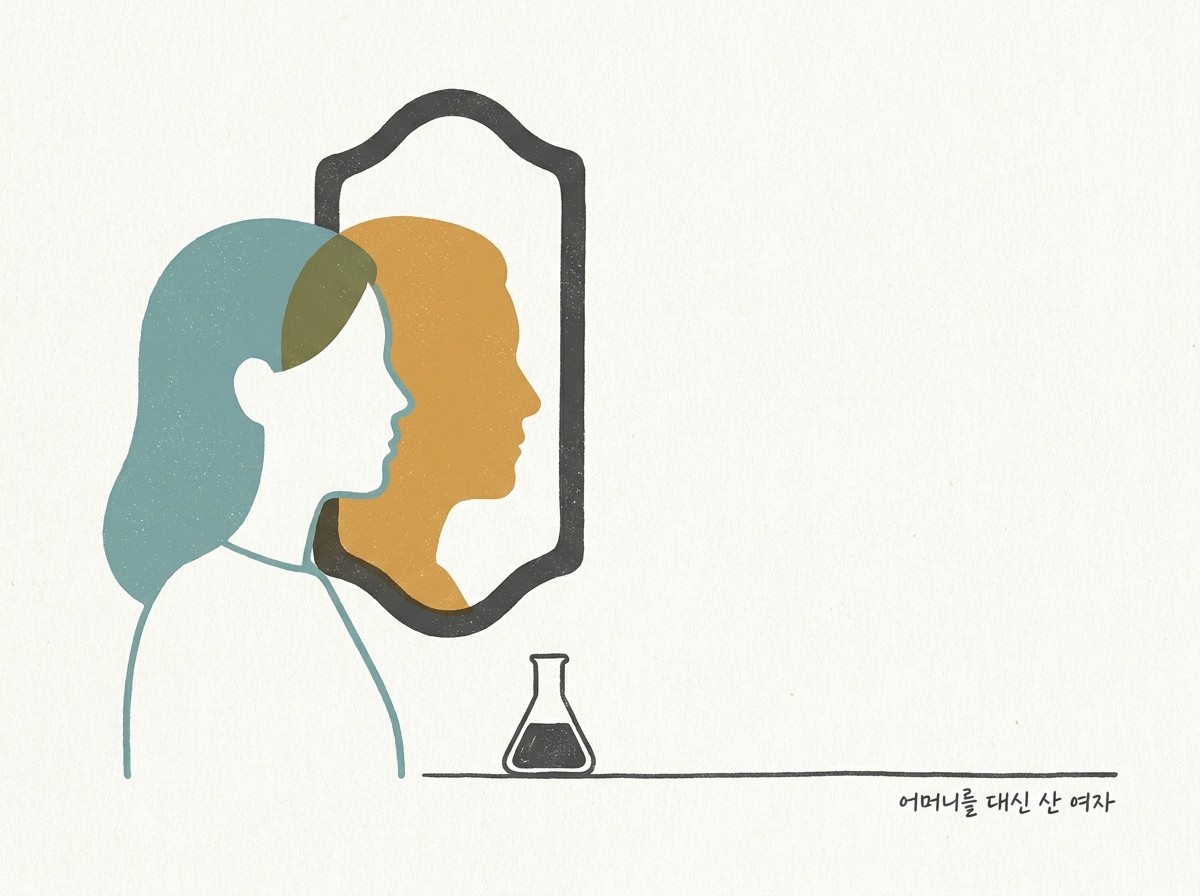
Sometimes a sentence comes out of my mouth that isn’t mine. I say something offhand to someone and then catch myself. The tone, the way the words get pressed flat at the end — they belong to the person I least wanted to sound like as a child. There are moments at the mirror when a parent’s face surfaces over your own; that was simply the audible version of it. I thought I had worked fairly hard at not becoming that person, and yet there I was, living in their voice.
To catch a parent’s face surfacing over your own at the mirror — anyone does that much. The question is what comes next. Some people see the overlap and step half a pace back; others take that overlapped face for their own and live a whole life inside it. There is a woman who lived her mother’s life over again — her profession, her love, even her way of dying. Ritsuko Akagi, of Evangelion. And the thing people usually say about her — that she inherited her mother’s fate — took me a long time to weigh, because to inherit a thing and to take it upon oneself are not the same.
The Seat She Inherited, and Yet
Let me be clear about one thing first. The seat Ritsuko occupies is not one she chose. There is Gendo, the man her mother Naoko loved; there is the MAGI, the system her mother built; there is NERV. Into the middle of what her mother’s discernment had gathered, the daughter steps, and people respond to her as they responded to the mother, and the seat assigns the daughter the very role it gave the mother — to be used, to be kept in service under a pretense of trust, and at last to be discarded. However sharp Ritsuko is, once she stands in that seat she does not get out of that role. The last scene — when she gives her mother’s machine its final command and the MAGI sides not with the daughter but with Gendo — is the closing of that seat.
Yi Je-ma (이제마, the nineteenth-century physician-thinker) would have looked at the seat first. In the Gyeokchigo (格致藁) he held that a person’s conduct does not issue from the heart alone. If I have discernment, people are bound to gather to me — 我有識見 人必歸我. But he adds another clause: if there is discernment without an inner conviction at its center (雖有識見 若無信心), then in the seat where people have gathered, I will surely come to deceive them — 我必行欺. The seat does push a role; but what cuts that push is the inner sinsim (信心), conviction. One in whom sinsim stands is not swept by the role in that same seat; one in whom it is empty rolls along with the momentum of the seat.
Here two things divide. The seat is given from outside. But the inner self with which one receives that seat is one’s own. To inherit a seat and to inherit a mother’s inner self are separate things. Ritsuko inherited the seat, but she had no need to inherit her mother’s kuk (局, the inner formation a person stands on). Had her sinsim stood, “I am not my mother” was possible in the very same seat. Her real trouble is not that she inherited the seat, but that her inner self was empty and so she received that seat in her mother’s face.
The symptom of that emptiness is her eye. Yi Je-ma held that once a mind hardens to one side, the hardening becomes one’s field of sight. If my own sincerity is not exhausted, the falseness of others is hard to know fully — 己誠未盡則人僞難悉 — a clouded eye fails, first of all, to see itself. The woman who reads everything, who read the structure of the MAGI and the logic of the dummy plug as no one else did, could not read the one chair she sat in. Her eye read the world sharply and read only herself as her mother’s echo. Not will but optics. The mirror had hardened to reflect the mother’s face alone. The seat came from outside, but that mirror hardened in the empty place inside her.
Where No Inner Self Could Stand
Then why could that inner self not stand? The history of that emptiness is Freud’s and Jung’s ground.
Freud would say the dead mother had come inside. The lost one does not vanish; she sinks and hardens. That line from “Mourning and Melancholia”: Thus the shadow of the object fell upon the ego. Ritsuko’s ego is the sediment of a lost object — the mother — settled and hardened. Ego and mother are not separated, so there is no ground on which an inner self could stand; the mother has taken that empty place. And so she loves Gendo as her mother did, is doubted as her mother was, discarded as her mother was.
Her pull toward Gendo unravels here too. The seat did not assign it — a seat does not decide whom one will desire. A daughter who has internalized her mother whole takes on even the mother’s desire as her own: to love the object the mother loved; to receive at last the love the mother never got; to outdo the mother and complete the mother’s unfinished business at once. This is not the work of the seat but of the inner self. Desire’s object comes from the individual; only where that desire rolls and closes belongs to the seat (jang, 場).
Jung would say the daughter never got out of the mother. When a mother-complex does not overflow into a capacity for love, it turns into identification with the mother and a paralysis of the daughter’s own initiative. Such a daughter does not live her own life, because the mother has already lived it for her in advance. Jung’s sentence is almost cruel: such a daughter leads “a shadow-existence, often visibly sucked dry by her mother, and she prolongs her mother’s life by a sort of continuous blood transfusion.” For Ritsuko the figure is nearly literal. The MAGI she tends each day is her dead mother’s mind, and her work is to keep that mind running. A daughter transfusing blood to her mother. Instead of building her own kuk, an appendage prolonging her mother’s.
What Freud and Jung together point to is one thing: the past mechanism by which an inner self — call it sinsim, call it kuk — failed to stand. She internalized the mother; she failed to individuate from her. So when the seat came down, the empty inside received it by copying the mother’s inside exactly. The order runs like this: the inside is empty (Freud and Jung), the seat is inherited over it (the jang of the Gyeokchigo), and the empty inside hardens into the mother’s kuk as it receives the seat.
Received in the Mother’s Face, Moment by Moment
Freud and Jung explain, from the past, why that inside was empty. But how the empty inside re-hardens into the mother’s face moment by moment — that, Buddhism reads in the present tense.
Buddhism does not accept the phrase “a woman who lived her mother’s life” to begin with. Karma cannot be detached and handed to another; a parent’s karma does not transfer to a child. As a shadow follows a form, only one’s own karma follows oneself. So to bring Ritsuko’s tragedy to Buddhism is to find that the mother did not pass it down — Ritsuko herself made it, moment by moment. This self-doing-self-receiving, which seems cruel at first, fits exactly when set not against the seat but against the inside. That she inherited the seat is not her doing; but each moment she received that seat in her mother’s face is her own working.
The engine of that working is craving — galae (渴愛, taṇhā). Because the inside is empty, she fills the empty place with Gendo’s recognition. The thirst to seek her own worth in his regard is the origin of suffering, and it turns the wheel moment by moment. The inside is empty so she craves; she craves so the inside cannot stand — two faces of one event. Even the mirror that reflects the mother is not given from outside. The Avataṃsaka Sūtra says that as the images in a bright mirror are many, so is the nature of karma. The mirror that reflects only the mother is an image her own karma made and cast.
The sharpest moment is the last. As she smashes the cloned tanks of the dummy system and despairs — “I too was a replaceable doll” — Buddhism answers instead: yes, you and the doll alike are without any fixed self-nature. That despair is not the realization of non-self (mua, 無我, anātman) but ego-clinging (ajip, 我執) turned inside out. Because she clung to the end to “a unique me,” “replaceable” becomes despair. To make an inner self stand is not to build one’s own hard I — that is precisely ego-clinging — and Ritsuko, trying to substitute ego-clinging for the empty inside, falls into thinghood (mulhwa, 物化) when it shatters. Her failure to form a kuk was itself ego-clinging. The hand smashing the dolls and the recognition that she too was a doll meet in the same place because both are the end of that clinging.
The Half-Beat She Never Returned To
Yi Je-ma always spoke of a single half-beat before the hardening. Just before one slides into deceit, a small turning-back that rises, each time in a different grain — banseong (反誠), the turn back toward sincerity. Not a destination but a minute motion returning, every time, to the starting line. For Ritsuko that half-beat never once fires. At the juncture where the empty inside is about to harden into the mother’s kuk, she never once returns to her own side.
What is striking is that Buddhism’s exit lies at exactly that juncture. The single instant of extinguishing craving — the moment of letting go the thirst to find oneself in Gendo’s regard. At the place about to harden into the mother’s face, let the craving go and the inside returns to itself. Banseong and the extinction of craving point to the same spot. The half-beat denied to Ritsuko — Gyeokchigo calls it banseong; Buddhism calls it the instant of quenching craving. Past that juncture, though, the two part. Gyeokchigo keeps the seat (jang) and turns the inside back to itself; Buddhism extinguishes craving and goes beyond even the work of building an inside, emptying the seat itself. From the same starting point, one stands within the seat and sets the inside right; the other empties seat and inside together.
This mirror is not the first. I have seen another mirror made by the same mother in this work. Rei. Only the hand holding the mirror is reversed. Rei is a being Yui shaped in her own image — the one reflected. Made from the start in Yui’s mold, she has never had an inside of her own. Ritsuko is the hand that holds the mirror — the one reflecting. Made from no one’s mold, able to live her own life, she filled that place with her mother’s image and emptied herself. One was never given an inside; the other emptied an inside she should have had. So self-doing-self-receiving is hard to press on Rei and fits Ritsuko. The same shadow of Yui produced, on one side, a being modeled on herself, and on the other, a daughter who copied her own mother.
So to close Ritsuko on either side alone makes both false. Say only that she could not let her mother go, and the weight the seat pushed is erased. Say only that the seat did it all, and her own share — receiving that seat in her mother’s face — is erased. The seat absolves; the inside is held to account. The seat cannot be changed. But whether to receive that seat in her mother’s face or her own was her share, and that division — the half-beat of rising, just there, into a different grain — was the thing denied her.
To catch a parent’s face overlapping your own at the mirror — anyone does that much. The hard part is the next thing: stepping half a pace to the side. Seeing and stepping aside are, in the end, two different acts. Ritsuko is the woman who saw more clearly than anyone and still could not take that half-step. When a sentence that isn’t mine comes out of my own voice and I can laugh it off, it is not because I am better than she is — only that the seat does not yet press on me that hard, and that, for now, there is still room left for me to step half a pace back from the overlapped face.