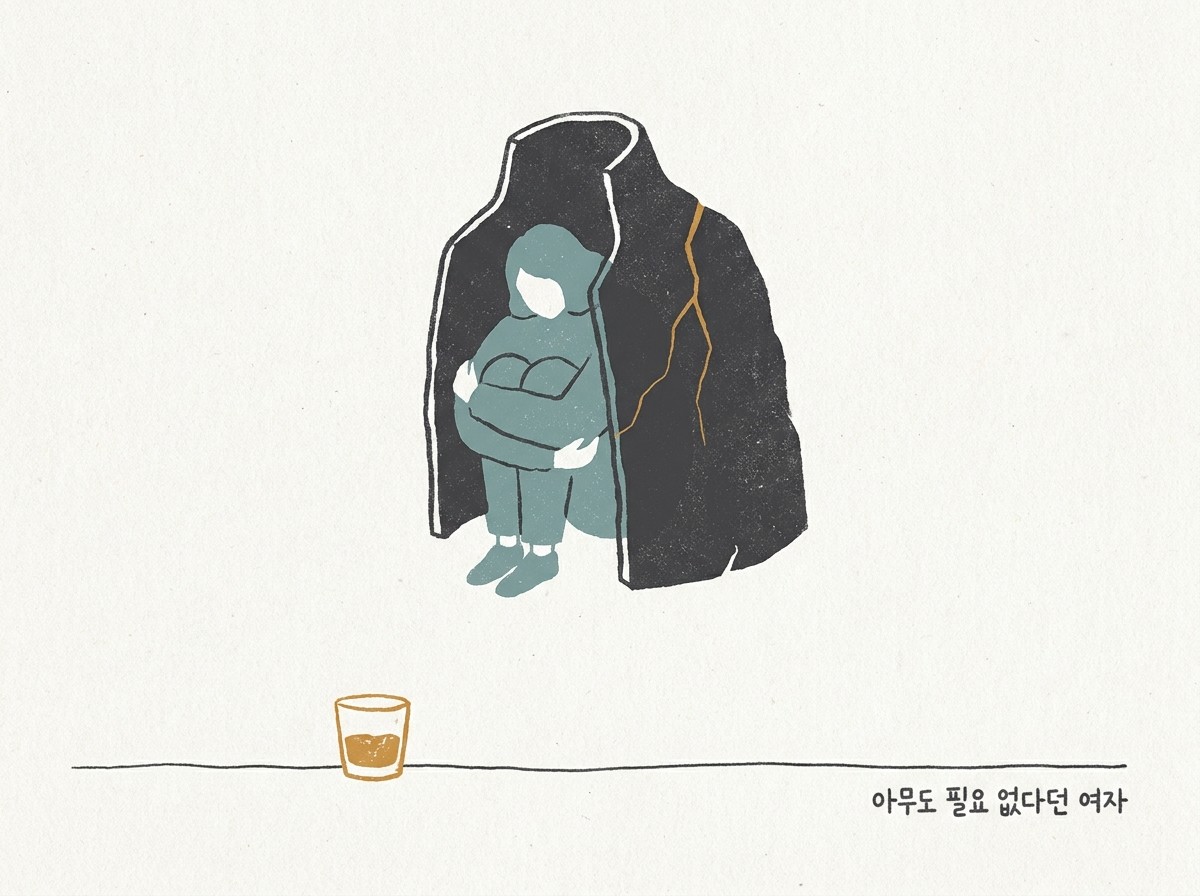
There is a kind of person who says “I don’t need anyone” often. Offer to help and they say it’s fine; show concern and they call it meddling; come close and they take a step back. From the outside they look solid—standing alone, leaning on no one. But listen to that line long enough and you notice something strange. The moment “I don’t need anyone” comes out loudest is always the moment someone has come near. A person who truly needs no one has no reason to say so. To have to say it, over and over, is because one needed.
Asuka Langley Soryu is the child who cried that line loudest. Self-assured, always out ahead of the others, hating weakness in herself more than death itself. For her there is one scene. When she was small and her mother, having lost her mind, lay in a hospital bed, that mother held to her breast a stuffed doll she took for her daughter, in place of the real daughter beside her. However the child said “Mama, I’m here,” the mother’s eyes saw only the doll. And in the end the mother took her own life, together with that doll. Keeping watch at her side was a child no one had held. And in that place there was no father. Not before the mother left, not after. The one who would have held her was dead, and the one who might have held her in her place never came.
The Armor of Needing No One — Freud
Asuka lost her mother, and could not let her go. Ordinary loss is followed by mourning, so that however slowly, one draws the departed back out of the heart and returns to the place of the living. But to draw back, there has to be someone to receive it. A crying child needs arms to be held in for the grief to drain away. Asuka had no such arms. The mother was gone, the father absent. With nowhere to leave, the grief stays shut inside and hardens into another shape.
Freud would have called that hardened shape narcissism. Love, he said, is by nature turned outward—a person sustains himself by loving someone and being loved by someone. When both the one to love and the one to be loved by disappear, that force of love loses its destination and turns back upon the self. Freud gave this condition the name of the Greek youth who fell in love with his own reflection in the water. Love that had faced outward folds inward and faces the self. Asuka’s “I don’t need anyone” is precisely that place. To need no one is not said out of strength; it is said because love, refused again and again on the outside, has at last turned in.
The trouble is that love turned upon the self cannot stand on its own. Freud said a person’s self-regard rests on three legs: one’s inborn self-love, the sense of having achieved something, and being loved by another. In Asuka the third leg is broken from the start. With no memory of being loved, she loads all her weight onto the other two—above all onto achievement, staking her whole self on being the best as a pilot. That ferocity about being the best is not ambition but a prop. She is trying to fill the empty place of not being loved with proof of having done well. For Asuka, first place is not pride; it is survival.
This structure is precarious. Having loaded everything onto one leg, when that leg shakes, everything collapses. When a better pilot appears, when her synchronization rate falls, when at last the Eva will no longer move for her—Asuka’s self-regard loses what held it up. When an Angel pushes directly into her mind and digs at the deepest place the armor had always covered, the prop gives way in an instant. And what shows through the breach in the armor is the child the armor had been hiding all along. The child the mother never held in the end, who came to believe she was not a child worth holding. The resentment that should have faced outward, having nowhere to go, turns back on the self, and breaks out at last in the form of breaking herself.
The Child Who Lives by Fighting — Buddhism
Asuka is always fighting. With her comrades, with the enemy, with anyone who does better than she does, and with herself. She is never still. When someone does better she cannot bear it; praise her and she bares her teeth. Buddhism has a place for a being like this. The asura (阿修羅, a-su-ra, a warring spirit).
The asura is a being that fights without end. In the sūtras the asuras take up arms and storm the world of the gods above. Their strength rivals the gods’, and what they do with that strength is fight. One asura king tries to threaten and deceive his opponent with phantom illusions, but at the end of those illusions waits only suffering through measureless ages. The king on the other side, in heaven, does not take up the fight. He has no need of such trickery, he says, and steps aside—offering instead to cure the other’s sickness. One side cannot stop fighting; the other never steps onto the field at all. The side that does not fight knows that what is innermost in all that threatening and swaggering is in fact the most afraid.
The asura has one curious condition: it must have an opponent to be an asura. The asura’s world borders heaven and is forever at war. Fighting is its very way of being alive. With no opponent, the asura grows faint. Asuka is just so. She comes alive most vividly when there is someone to collide with. Someone to compete with, someone to defeat, someone too weak-seeming to bear. Before that someone, Asuka becomes most herself. Fighting sets her up.
Here Buddhism would point to one thing more. To fight like that, there has to be a firm “I” to do the fighting. An “I” that must win, an “I” that must not be slighted, has to stand first, solid, for the fight to hold. Let that hardened “I” go, Buddhism says, and the fighting goes with it. If there were no “I” to quarrel over to begin with, where would hatred or contest arise. But to Asuka that road is invisible. To set down the fight is, for her, to lose, and to lose is to vanish. To a child who lives by fighting, being told to stop fighting is the same as being told to die.
Two Children Who Hardened Against Each Other — Yi Je-ma
Before this child I think of Yi Je-ma (이제마). A person sets up his own place with his own body, he wrote—我身立局, a-sin-rip-guk, my body sets up its configuration (局, guk, the shape into which a single person has settled). I stand, and my place comes into being, and that place in turn settles what I am able to do (局命我能, guk-myeong a-neung). A child who stands in a place with no mother and no father has few things she can do. To grow strong alone. That place commanded Asuka onto that road. She must not weaken, must not lean, must do everything by herself. The armor of narcissism was not something Asuka put on out of hardness; it was what a child standing in that place had to put on to survive.
Of that mind that hardens in one direction only, Yi Je-ma wrote this:
太陽之人雖好爲雄亦或宜雌 若全好爲雄則放縱之心必過也
A person who loves to be the dominant one still ought, at times, to take the lower place; if he loves only to dominate, the unbridled mind will surely run to excess. A mind, by nature, must be open in two directions to flow. It must know how to grow strong and how to grow soft, how to set itself up and how to lean. Close one direction off entirely, and what had been flowing hardens in that direction. Asuka left only the one direction, strength, and closed the rest. She would not go a single step toward weakness. That closing hardened Asuka into one mass.
And that hardened child meets another child hardened just the same. Shinji. The two have something alike in them. Shinji too lost his mother, and was left, all but abandoned, to his father. In being children with no mother and no father near, the two start from the same place. That same wound, the two block in opposite ways. Shinji shrinks inward and closes himself. When someone comes near he runs; rather than be hurt, he would do nothing at all. Asuka, the reverse, sets herself up outward. Rather than seem weak she acts stronger than anyone, and strikes away the approaching hand first. One crouches and closes, the other stands bolt upright and closes. Only the direction of the closing differs; both are children who have shut their skin tight.
So when the two collide, sparks fly. Shinji’s shrinking lays out before her eyes the very weakness Asuka has pressed down with all her strength. The thing she is most ashamed of, Shinji is showing without shame, and she cannot bear him. “Why are you so spineless”—that line is in truth aimed at the weakness inside herself. The harder she drives Shinji, the more he shrinks, and that shrinking goads her again. The two children become mirrors of each other, and the more they collide, the harder each makes the other. As the asura must have an opponent to be an asura, so Asuka burns most vividly before the opponent that is Shinji. And the very place where she burns most vividly becomes, in the end, the place where she breaks.
The Child Who Could Not Step Back
Asuka’s end is merciless. After the armor is breached she becomes, for a time, an invalid who can do nothing. At the last she rises once more to fight, and even that fight ends in ruin. To the end she stays closed, pushing away another’s touch with the words “how disgusting.” No release comes.
One wants to read this end as Asuka being punished for being bad, for her nasty temper. But Yi Je-ma would not read it so. To him, a mind hardened in one direction is not a sin but a diagnosis. As the same water becomes a spring or a river or a sea according to where it pools, so the mind differs only in where it hardens; there is no bad seed set apart from the beginning. Asuka’s narcissism, and her endless fighting, are not inborn evil but the marks where a child standing in a place with no mother and no father hardened in order to survive. In that place, anyone might have hardened so. Nail Asuka down as a nasty child, and how that hardening was formed becomes forever invisible.
Yi Je-ma set down one road out of the hardening. Nothing grand. In the very instant the mind starts to harden in one direction, just before it hardens, to slip off elsewhere and come back to one’s place. He confessed that even at fifty-seven the mind that would harden rose in him every time, and that each time he was obliged to crawl back to his place. It neither releases at one stroke nor ever arrives. A repetition without end point: hardening again, returning again. What Asuka lacked was exactly that returning. She only drove straight ahead in the one direction of strength, and not once turned back out. Had she known how to step back half a pace toward weakness, had she known how to take someone’s hand even once, it might have gone differently. But to a child who lives by fighting, stepping back was defeat, and defeat was vanishing. So instead of returning she collided, and colliding, broke.
I have seen this hardening in another story too. A man who set himself down entire on the spot where he lost his wife and could not move a step. He hardened inward because he could not let go; she collided outward because she could not let go. One closed and turned to stone; the other collided and broke. The roads parted only into hardening and breaking; both children, in the end, could not lift that one foot that turns back out.
The line from the beginning returns. “I don’t need anyone.” Now I know how it sounds. It is not the line of someone who needs no one, but of someone who needed and in the end did not receive. The louder a child cries “I don’t need anyone,” the longer, perhaps, that child has waited for someone to hold her, just once, properly. In that hospital room where the mother held the doll, the voice calling “Mama, I’m here” was there, to the very end, inside that one line.