There’s a thing that happens when you see a film at twenty and then meet its sequel past forty. The strange part isn’t that the character on the screen has stayed the same; it’s that you, watching, have not. A scene that once struck you in the chest now makes you smile instead. And there is something lonely in the smile.
For me it was Asuka, in Evangelion. At twenty I was bound up in the old series — in the way Shinji and Asuka couldn’t stand each other and yet couldn’t let each other go. When I saw the Rebuild films in my mid-forties, that same Asuka had grown up beside an entirely different man and would never be with Shinji at all. Shinji had gone to another woman. Walking out of the theater I laughed a little and felt a little hollow. So, I thought. First love is over.
People like to say that in the Rebuild films Asuka was finally healed. But that is not what I want to weigh here — whether she got better. What I keep wondering is something else. That relationship she could not release in the old series — how did the new films make it possible for us to release it? And not through grief, but through a small, rueful laugh.
A Dead First Love, and One That Lived On and Moved Away — Freud
Freud wrote that there are two paths through loss. The fourteenth volume of the Standard Edition, “Mourning and Melancholia.” Melancholia is the failure to let a lost object go — drawing it inward instead, hardening around it. The reproach that should have gone to the object loses its address and turns back on the self. Freud pressed this into a single sentence.
Thus the shadow of the object fell upon the ego.
The shadow of the object falls across the ego. The lost one does not leave; he clings on inside you, and instead of hating him you come to hate yourself. Mourning is the opposite. It is labor — lifting each memory in which one’s love is bound to the object, taking hold of it once more, and loosening from it there. Not at a stroke but bit by bit, at great expense of time and energy. Only when that work is done does the ego grow light again. The lightness of mourning is the wage of that labor.
In the old series Shinji and Asuka were melancholia. Two hardened people who could not release each other, colliding until, at the end, one closes a hand around the other’s throat. A relationship neither could let go, pulling them both down from inside. I have seen this place once before. Gendo — the man who hardened because he could never let Yui go, left inside Unit-01. An object dead and yet not gone, and therefore impossible to release. Old-series Asuka, and Gendo, both hardened from failing to let go. Melancholia has no exit, so long as the object stays there, dead or embalmed.
What the Rebuild films did was refuse to kill the object, or to embalm it. Asuka grows up, perfectly fine, beside Kensuke; Shinji goes to Mari. Not tragedy, not idealization. Each simply finds a different partner and lives an ordinary life — anticlimactically calm. And that very anticlimax is the decisive thing. A first love that ends in tragedy, or is kept as memory, stays melancholia for life; but one that lives on, out of reach, simply doing fine with someone else — galling, deflating, yes — can at last be let go. A dead absence cannot be released and hardens; an absence that lives and recedes can. That deflation, Anno handing Asuka off to another man, turns out to have been the one condition that made mourning possible.
One thing becomes clear here. The one performing this mourning is not the Asuka on screen. She does no labor of loosening her own threads, one by one. She simply lives another life. The one loosening the threads is the audience. The person who at twenty was bound to that collision, at forty watches its ending and loosens the threads of his own first love. The screen sets the object to be released alive and at a distance, and leaves the releasing to the one watching. It shows itself in a feeling melancholia lacks and only mourning has. The rueful laugh. Tragedy has no laughter in it, and neither does obsession. That hollow, smiling so, I’ve gotten old — that is the exact texture of a thread coming loose.
The Asura Whose Opponent Vanished — Buddhism
Anyone who watched old-series Asuka for long read a permanent combat stance in her. Sharpening her edge before anyone touched her, hating to lose more than death, turning whoever stood near her into a rival. Buddhism would have called this place the asura (阿修羅, asura, a being whose power rivals the gods’ but whose mind is full of greed and envy). The asura makes its very existence out of endless war with heaven. The sutra names the root of that war plainly: all enmity arises from greed and envy.
What is strange is the nature of what binds the asura. There is a story in which the asura king Vemacitra, defeated by heaven, is dragged in bound by five cords. The cords were not fastened by heaven. The moment the asura king held heaven in his mind as enemy, he was bound again; the moment he resolved to stop being an asura and to live here, they fell away of themselves.
I no longer delight in being an asura. From now on I will live here, in this heavenly palace.
At that thought, the sutra says, the bonds loosened on their own. What imprisons the asura is not an outer enemy but the mind that sets the other up as enemy. Lay down the enmity and they loosen; name the enemy again and they bind.
But what happened to Shikinami looks like this loosening and is, in its grain, different. She did not lay down her enmity. The opponent was simply removed from the outside. When another person stepped into the seat beside Shinji, the very object of collision vanished. Vemacitra loosened the cords by ceasing, himself, to hold heaven as enemy; Shikinami never ceased to hold an enemy as enemy. The enemy merely disappeared from in front of her. So her calm is not the calm of bonds undone. It is the kind of stillness in which a combat stance, finding nothing to seize, loses its direction and sinks. Let the enemy appear again and the cords will revive. Not undone — only resting.
Not Loosened but Lifted Away — Yi Je-ma
Once you pass through Freud and Buddhism in turn, you can see the two paths pointing to one place. That getting free of loss, and untying the cords of enmity, are in the end things one must do oneself. I do the labor of mourning; I am the one who stops seeing the enemy as enemy. And Shikinami did neither, and grew light all the same. To follow this discrepancy to its end, it helps to open Yi Je-ma (李濟馬) once.
Yi Je-ma wrote a person’s standing in four characters — 我身立局 (a-sin-rip-guk, “my body sets up its guk”), in the Gyeokchigo (格致藁). It means the body hardens into a single cast of character and stands. What matters is that this hardening does not come from the other. A person hardens to one side because he has himself let go of something he was meant to hold, not because someone made him so. Old-series Asuka’s hardening was like that too. Shinji did not harden her; she collided with Shinji already hardened.
Then will the hardening loosen because the one she collided with is gone? Yi Je-ma would say no. When the collision goes, only the friction that the hardening produced falls quiet for a while; the hardened thing itself stays as it was. Let a place to collide open again, and it will collide again, hardened in the same way. The path that loosens hardening lies elsewhere, and it has nothing at all to do with the other’s disappearing. In the very instant the mind begins to flow toward falsehood, just before it acts, to turn back and surface to one’s own place — that, and that alone, Yi Je-ma called loosening (反誠, ban-seong, the return to one’s true ground). In the middle of the collision, by oneself. A stopping that comes from the other’s vanishing is no more than a stone cleared from the road.
So Shikinami’s stillness is not the loosening Yi Je-ma meant. Her hardening was not loosened; the place she had to collide with was lifted away from the outside, and she sank. Mari makes this clearer if you call her to mind. The work never gives Mari any thickness. It barely draws her past or her inner life, letting her drift on a pair of glasses and a hummed tune. That is not a mistake but because Mari’s role is less a person than a device that moves a seat. For the single scene at the end where she takes Shinji’s hand and leads him away from the platform, the seat that in the old series belonged beside Shinji to Asuka is emptied. Shikinami did not walk out of that seat herself. Her seat was simply cleared from the outside.
Here is this film’s strangest craft. From the figure on screen it exempts the loosening — the turning-back-and-surfacing one must do oneself. Shikinami did not loosen by growing kind, or let go by waking up. There was simply nowhere left to collide. And the work sets exactly that exempted figure — the one who loosened nothing by her own hand — alive and at a distance before us. And the loosening it hands to us, outside the screen. The labor it took back from the character, it lays on the audience.
What Did the Sending Was Always the Audience
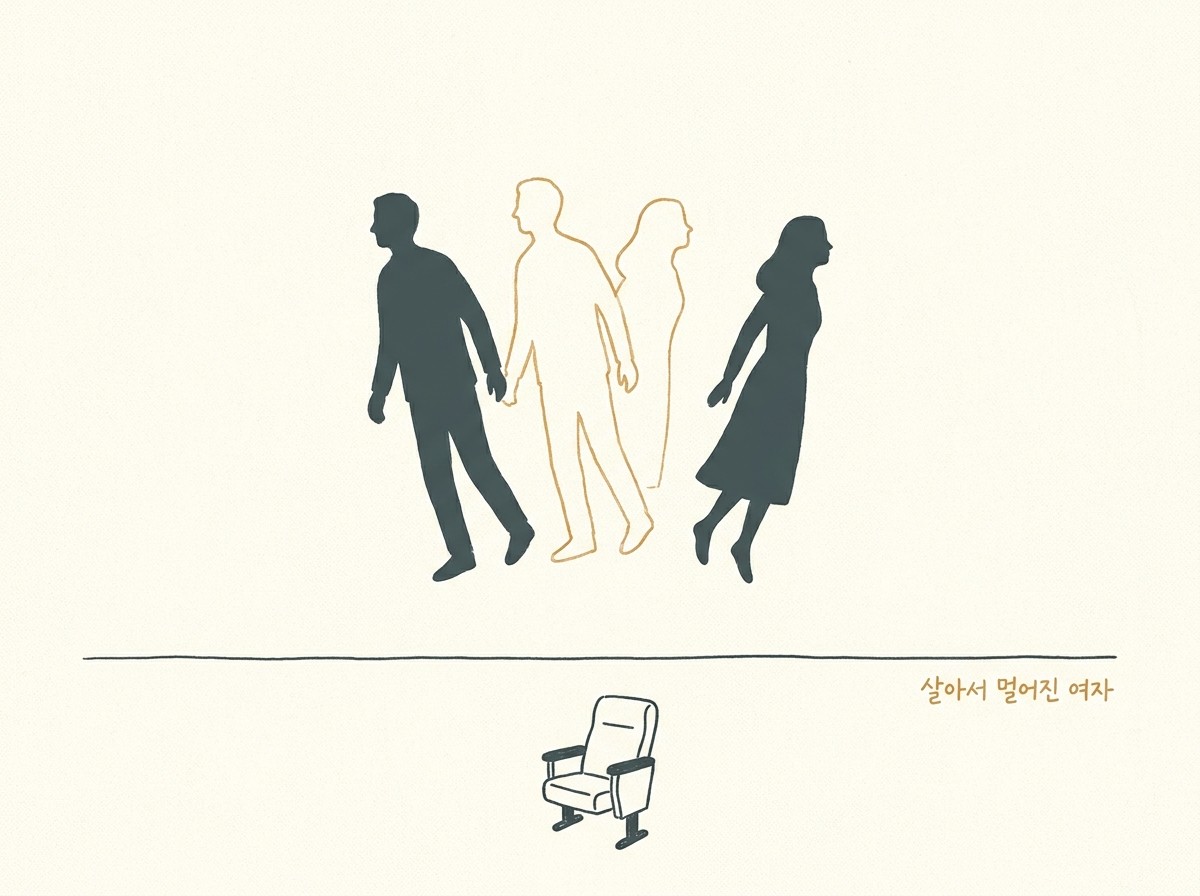
So the same ending reads two ways. Setting Asuka beside another man and sending Shinji to another woman — some see in it an author clearing his old love far away, a settling of accounts. Some see two people who could never release each other set free, at last, of each other. It reads as deflated revenge and as quiet mercy both. Yet these two readings are two faces of one fact. Both come from the single act of lifting away the place of collision. Take that place away, and to one it is abandonment and to another release. So this essay does not close on one of them. The place where a collision once stood looks different depending on what the one watching is carrying inside.
Only one thing is certain. Freud, the sutras, and Yi Je-ma all said, in the end, the same thing: the sending is something you do yourself. And Gendo hardened, unable to send a dead object; old-series Asuka broke, unable to send that collision; Rebuild Shikinami had even the sending lifted away from the outside. Not one of the three sent by their own hand. What did the sending was always outside the screen. Watching Gendo, watching old-series Asuka, and at last watching Shikinami, the one who sent off his own first love was, always, us, in our seats.
That evening leaving the theater comes back to me sometimes. If at twenty I was inside that collision, at forty-something I was watching it end. The Asuka on screen did nothing in the end, and yet the one who set something down was me, in my seat. The lightness of a heavy thing carried long and then set down, the arm rising a little on its own. Hollow before it is a relief, and yet unmistakably light.
That, it seems, is how first love ends. Not because someone died, not because someone turned hateful. Just because you come to know they are living well somewhere. And so you smile a little, grow a little lonely, and then rise from your seat.