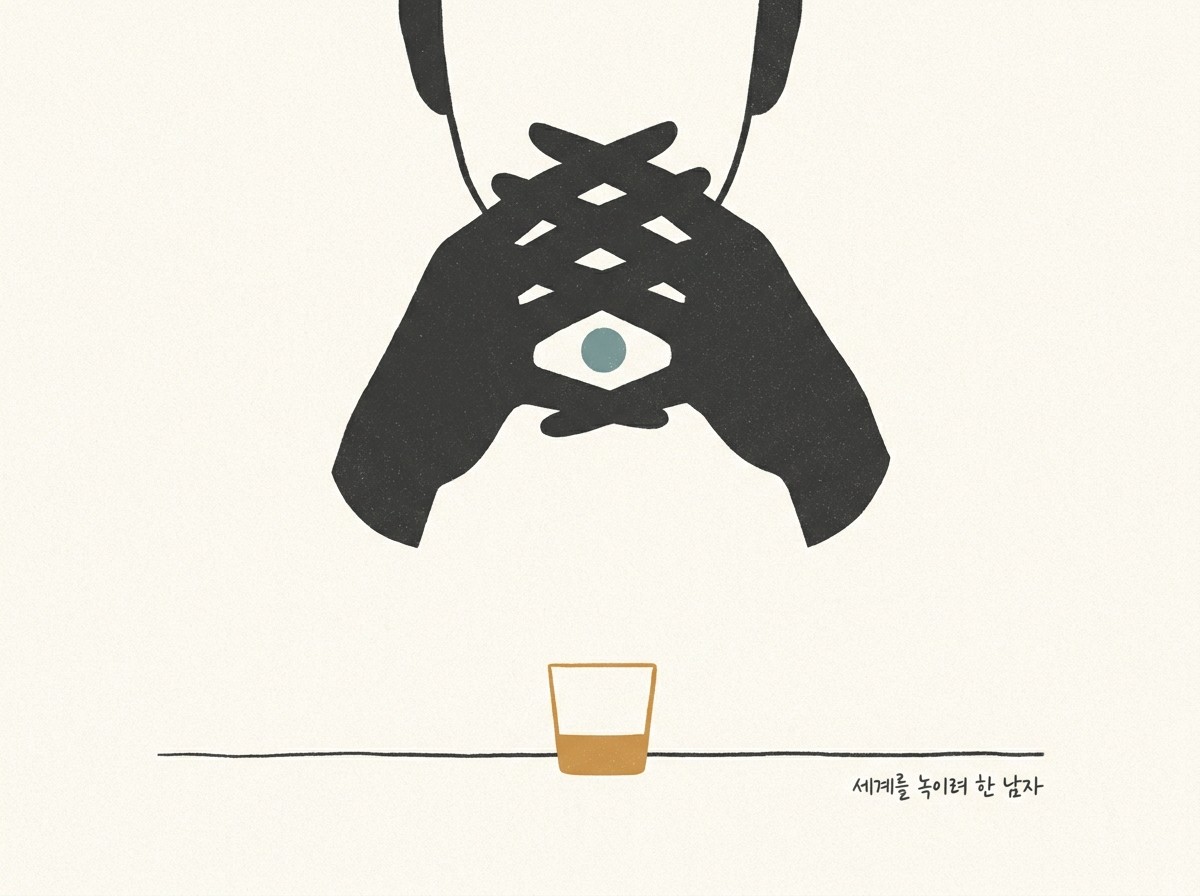
In my practice I have come to watch where people put their hands. Words can be dressed up; hands are harder to dress. The at-ease let their hands fall anywhere; the tense gather them. And there are those who lace their fingers and hold them against the mouth, looking out at you only over that hand. The hand covers the lower half of the face. It looks like the posture of someone deep in thought, but watch long enough and it is less the posture of thinking than of closing—the mouth sealed by the hand, the world let in only through the gaps between fingers.
Ikari Gendo is drawn almost entirely in that one posture. Fingers laced at the mouth, looking down through the light off his glasses. He commands NERV, an immense organization, and through the whole work he sits at the same desk, in the same chair, in the same shape of hand. His face hardly changes. Enough to make one wonder whether a person can harden so completely into a single posture.
The Suffering of Parting — Buddhism
That hand, seeing the world only through its gaps, is also a hand clenched around something. What is it he cannot put down. Buddhism would begin from that question.
Buddhism counts a person’s sufferings as eight, and one of them is the suffering of parting from those one loves. The Āgamas call it 愛別離苦, ae-byeol-ri-go, the suffering of separation from the beloved—parting from one held dear, they say, is the thing the world finds hardest to bear. That is exactly where Gendo stands. He is a man parted, most deeply, from the one he loved.
But what Buddhism looks at is not the parting itself; it is the mind that clings to what has been parted from. One sūtra says that everything the world takes for pleasure—people, wealth, love—is in truth a seed of suffering. There is a line in it about a man who, on account of a woman, falls to worry and to weeping and at last takes his own life. The very thing that gave pleasure, the instant it is grasped, turns to suffering. We grasp because it pleases, and from the moment we grasp, it binds us.
This is Gendo exactly. Yui was his greatest joy, and so became his greatest suffering. As large as the love was, that love binds him whole. Here Buddhism would point to one road: to accept that all things do not stay but change and pass, and to open the hand clenched around that single point. Let what is gone be gone, and the suffering loosens with it. Gendo does the precise opposite. Rather than accept what changes and passes, he holds the vanished as the eternal. The hand that should open, he closes the harder. That hand he cannot open is the laced hand at his mouth.
The Man Who Dropped Anchor — Yi Je-ma
The same hand, Yi Je-ma (이제마) measures with a different rule. Where Buddhism tells him to open the hand, Yi Je-ma looks at why the hand was nailed to one place to begin with.
Yi Je-ma wrote that a person sets up his own place with his own body—我身立局, a-sin-rip-guk, my body sets up its configuration (局, guk, the shape into which one person has settled). I stand, and my place comes into being, and that place in turn calls forth what I am able to do (局命我能, guk-myeong a-neung). This is by nature a living, moving thing. The place flows, and the one standing on it flows too. Yesterday’s place is not today’s, and so a person stands again, a little differently, each day. But Gendo nailed that standing to a single point and fixed it. On the spot where Yui vanished he set himself down entire, and from there he does not move a step. The world flows, and that one place does not.
In the earlier essay, writing of Yui, I also used the word hardening. Only, Yui’s hardening came of unbinding. She unbound her own place by her own hand to become the ground all others tread, and remained, unclosed, forever. The one who pulled out the anchor and poured it over all. Gendo stands at the exact opposite pole. If Yui hardened by pulling out the anchor, Gendo hardens by dropping it—at one place, into one point. One had unbound so far there was no place to return to; the other has driven in so deep there is no place to leave from. The directions are opposite, and yet from that place neither one ever turns back out again.
Around the point where that anchor dropped, everything else hardens in turn. Yi Je-ma wrote that when a man holds great power, others gather to him until the place itself assigns him such a role. With Gendo it runs backward. His one hardened point assigns the roles to the whole world instead. NERV, the war against the Angels, even his pacts with the larger hands that back him—in the end all become tools for reaching that one point. Nothing is more real to him than the single point that is Yui.
The deepest mark is left on two children. He shapes Rei from the face of his dead wife and sets her in the empty place. So when he looks at Rei he does not see Rei; he sees Yui beyond her. When he looks at his son he sees not a son but Yui’s son, a variable in the plan. Shinji, wanting to be caught by his father’s eye, stands before the things that frighten him and runs and comes back, again and again—and the hardened eye never once sees the boy as a son. The most ordinary thing in the world—a father knowing his own child—becomes, for this man, the one impossible thing. It is not that he is cruel. An eye born of a hardened place can see no other way. The most terrible coldness comes not from malice but from an eye like this.
Because He Cannot Let Go — Freud
The place Buddhism calls clinging and Yi Je-ma calls hardening, Freud marks with yet another word. When a person loses someone loved, he said, the mind goes two ways. One is mourning. However long it takes, the mind draws back the ties that bound it to the departed, and in the end lets the person go and returns to the place of living. The other is melancholia. Here the drawing-back does not happen. Instead of letting the departed go, the mind takes them inside and makes them one body with itself. The loss of an object turns into the loss of the self. Take the lost one in this way and it is the living one who empties out. That Gendo shows almost none of the ordinary signs of being alive—wanting, taking pleasure—is for this reason. He took Yui in, and emptied himself in her place.
Gendo’s melancholia carries one thing more. Ordinary loss has at least the clear end of death, and however slowly, the dead can someday be let go. But Yui did not die and vanish; she remains inside Eva Unit-01—just past the reach of the hand. A place that can be neither mourned nor met again. Freud would have called her the object never lost. An object that never got the chance to wear down against reality holds the mind forever, perfect. The living wear away—they quarrel, disappoint, grow old, and are loosened a little at a time—but with Yui that chance of loosening itself was lost. An absence that can be let go, melancholia someday releases; before an absence that cannot, it lasts a lifetime. And that lifelong melancholia does not stay one man’s grief; it grows into a design that swallows the world.
A Hardness Wearing the Face of Release — Yi Je-ma
The Human Instrumentality Project. To melt every person’s boundary, erase the line between you and me, and return the scattered minds to one. The work holds this up wearing the face of a vast salvation. A place with no loneliness and no wound, where all are one.
There is a familiar shadow in that release. To melt all boundaries and become one is not far from the place Buddhism calls non-self—unbinding the membrane that is the self, erasing the wall between you and me. Earlier, Buddhism told Gendo to open his hand. And Instrumentality takes up that very release—not by opening the hand, but by melting the world entire. The same release, in the opposite direction. Buddhism’s release sets the self down to make room for others; Gendo’s release melts the world to return to one single person. He takes the teaching that says let go, and uses it in order not to let go. The largest release of all, the one that would make everyone one, rises from the hardest hardening of all, anchored to a single point. A hardness wearing the face of release.
The contradiction runs deeper. The one point he means to reach is the least meltable place in the world—unreached even by death, slipping the grasp, the single point hardened hardest of all. And to reach it he melts every surface around it. When all boundaries melt and become one, that one point melts and passes along with them. In the very instant of reaching, the thing to be reached is gone. To erase all hardness in order to reach the hardest thing—and so Instrumentality, even fulfilled, is failure. The road he gave a lifetime to, carried to its end, is the road that erases with his own hand the one he meant to meet. He never knows it. For the eye that sees was itself born inside that hardening. And pressure that builds only inward bursts somewhere at last. That vast attempt to melt the world entire is itself his rupture—what hardened in one man for decades, breaking out at last at the size of the world.
The Man Who Never Once Returned
In the end Gendo does not reach. Shinji will not take the oneness his father holds out; Instrumentality halts; the world stands again, each with its own boundary raised. To the place he would have melted the world to reach, he is left without reaching.
One wants to read this end as punishment for being evil. But Yi Je-ma would not read it so. For him, hardening is not a sin. It is only the state of something that was flowing, lodged in one place. As the same water becomes spring or river or sea by where it gathers, so a mind differs only by where it hardens; there is no bad seed set apart from the start. And Gendo’s hardening came not from too little love but from loving one person too deeply—a love that could not in the end come unbound, and turned to stone. Nail him as a villain and you will never see how that hardening was made.
At fifty-seven Yi Je-ma wrote that the urge to harden still rose in him each time, and each time, unable to do otherwise, he crawled back to his place. Not loosened in one stroke, not arriving anywhere in the end. Returning again and again, hardening again and again, an endless repetition with no end point. That small motion of slipping aside just before hardening and returning to one’s place he called 反誠, banseong—not a grand repentance, not a single instant of awakening, only the returning, a little, each time. What Gendo lacked is exactly that returning. He is a man who never once, in a whole lifetime, raised the anchor he had dropped.
What that returning looks like is shown at the other end of this story. If Gendo hardened by dropping anchor at one point, at the far opposite end there is a boy with no anchor who melts into everything—the release Buddhism told Gendo to open, carried all the way through. But to melt away entirely is no answer either. Between hardening into breakage and melting into nothing, the one step that neither hardens nor melts but returns to its place each time—follow the story of yet another boy, who keeps running and at the last takes that one step, and you begin to make out, faintly, what the returning Gendo never managed might look like. The knot the hardened father never untied, the wavering son unties. That salvation comes not from the hardest place but from the weakest is the small turn this story holds out only at its end.
I look again at that hand. The laced hand at the mouth, the world seen only through the gaps between fingers. At first I took it for the posture of a strong man. One who does not waver, who breaks under nothing. But watch to the end and you find it is not strength but the mark of someone who could not, for too long, let one person go. The hand over the mouth was not to push the world away but to keep one person shut inside its hollow. Not a posture of reaching no one, but of not coming loose from a single person.
When I see a person gather their hands now, I think first not of what the hand is shutting out but of what it is holding on to. Inside the hardest-looking posture there is often the softest thing, the thing one cannot bring oneself to put down. Gendo’s laced hand was just so. The one—already melted, already gone—he would have melted the whole world to hold.