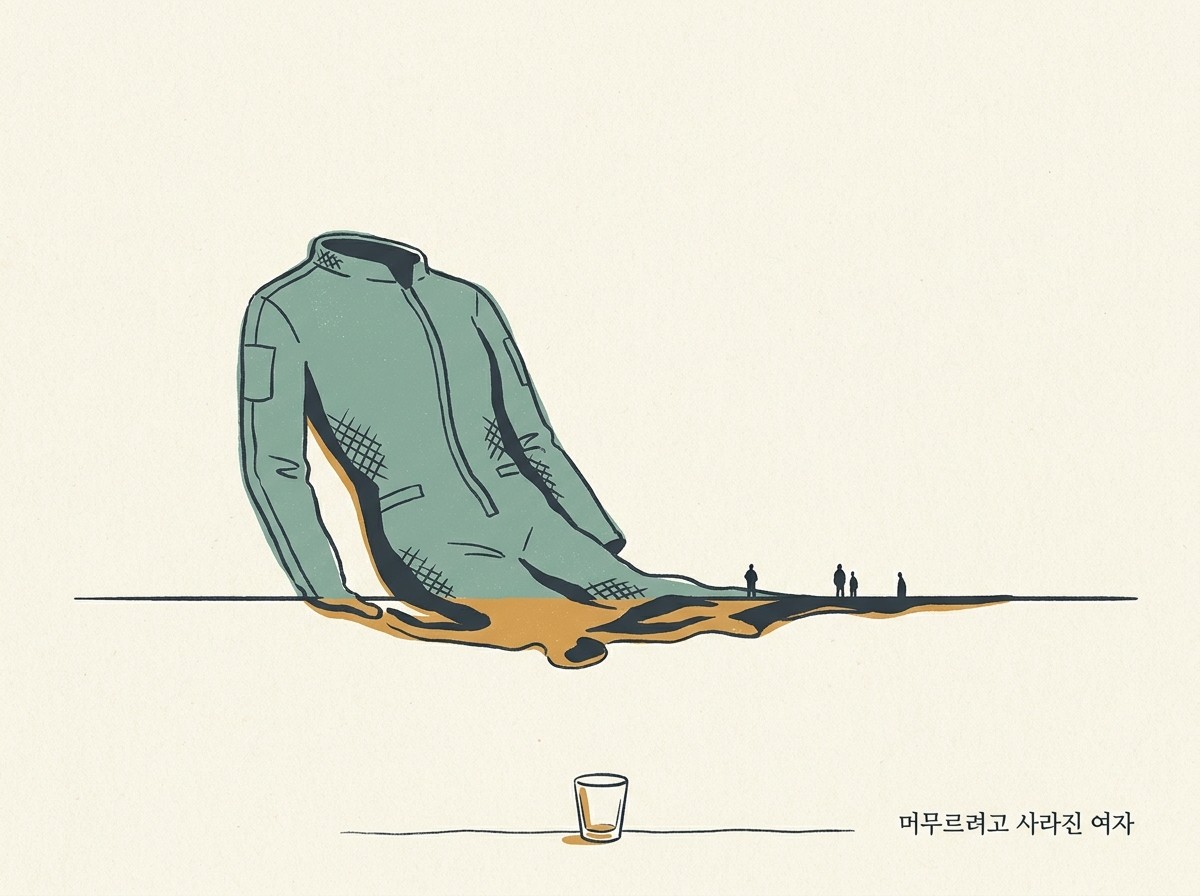
There is a piece of test footage. A woman walks into a vast machine, and a few seconds later nothing is left where she stood. An empty work-suit sinks slowly to the floor, and beyond the glass a man watches it. It is filed as an accident, but each time I watch, the word accident slides off. An accident is something done to you. And her face was not the face of someone to whom something was done.
Ikari Yui. Shinji’s mother, Gendo’s wife, the scientist who built Eva Unit-01. In the work she barely appears—a few flashbacks, one photograph, that footage. By screen time she is among the least seen of anyone. And yet the whole work turns around her. That Gendo would melt the world, that Rei was shaped in her face, that Shinji pilots that machine—follow each to its end and you arrive at this one vanished woman.
The person least present and most present at once. How is one to read that contradiction. If what I saw in reading Rei was someone not yet clearly standing, Yui stands at the opposite pole. One who stood clearly unbound the very place she stood and became something else—and did so wearing the face of the largest love. So she has to be seen first through the eyes of Buddhism. That is where the most beautiful place in the work lies.
To Remain, She Vanished — Buddhism
Buddhism has many stories of the bodhisattva casting away the body. Feeding one’s own flesh to a starving tigress; flaying one’s own skin to make paper for a single line of truth. The Mahāprajñāpāramitā-śāstra (大智度論) calls this 內布施, nae-boshi, the inner gift—「不惜身命 施諸眾生」, to give to all beings without sparing body or life. Why go so far. A line from the Mahāpuruṣa-śāstra (大丈夫論) answers: 「他命即是我命」—because another’s life is my own life. The bodhisattva gives his life to guard another’s, and that other’s life is already his own.
This is what Yui did. Under the name of a contact experiment, she put her body and life into the machine—to become the vessel her son would live inside, to become the one ship in which humanity might at last survive. Because Shinji’s life was her own. If I had to name the one who loved most in this work, I would name Yui. No one else gives their own body to become the membrane a child enters and lives within.
But the bodhisattva’s act has one more part. The one who casts away the body does not vanish into extinction. The Mahāpuruṣa-śāstra says that to give body and life and still not re-enter liberation—this is the most excellent (最勝). Wŏnhyo wrote: 「具足般若海 不住涅槃城」—complete in the sea of prajñā, yet not dwelling in the city of nirvana. Not to awaken and go quietly out, but to remain, on purpose, in the very midst of birth-and-death where beings are. Yogācāra gave this place a name: 無住處涅槃, mu-ju-cheo yeolban, the nirvana of no fixed abode—dwelling neither in birth-and-death nor in extinction, remaining only for others, benefiting beings to the far end of the future. As Kṣitigarbha defers his own buddhahood and stays until the hells are empty.
The place where Yui remained is like that. She did not die and vanish; she remained inside Unit-01. More precisely, she became the ground on which all the others stand. Yogācāra has a word: 阿賴耶識, ālaya, the storehouse consciousness. In the deepest place of the mind it holds the seeds of all things (「此能執持諸法種子令不失」), and every other mind and body and world leans upon it—as the root of a tree is the origin of stem and branch (「譬如樹根是莖等本」), the root that bears up everything. And that root does not merely bear up, quietly. When the time comes, the seeds within it sprout, and everything that happens rises from there. Yui becomes the floor that bears everyone, and the storehouse of seeds from which every event germinates. A ground that flows without rest and is never cut. Yui became exactly such a thing. Unit-01 is the vessel that holds her soul, and the root that holds the seed that will survive even if humanity perishes. Everyone stands upon her—Gendo’s design, Rei’s body, Shinji’s boarding.
Here Yui parts from Rei, and from the Kaworu still to come. Rei’s non-self is a dimness not yet lit; Instrumentality’s non-self is every membrane melting and going out as one. Both are a vanishing. But Yui did not vanish. She did not enter extinction; she remained to the end, watching her son. Not melted away, but giving up the body in order to stay. In that place where self and other are not two, unbinding her own boundary to become the ground of all and remain forever. Through Buddhist eyes, Yui’s vanishing is compassion in its most complete form—giving her own body as a ship, and remaining aboard that ship, as a bodhisattva, to the end.
The One Who Pulled Out the Anchor and Poured It Over All — Yi Je-ma
How would Yi Je-ma (이제마) see this love. First, one thing must be made plain. Neither Yi Je-ma nor the Confucian ground he stands on looks down on the death that gives the self away. They count it, rather, as the very limit of the human path. Confucius said 「志士仁人 無求生以害仁 有殺身以成仁」—the resolute and humane do not seek life at the cost of humaneness; some kill the self to complete it. Mencius said that when life and 義, ŭi, rightness, cannot go together, one lets go of life and takes rightness (捨生取義). The loyal minister, the filial child who throw their lives down for country, for parent—Confucianism honors them highest. So how could Yi Je-ma look down on Yui, who threw her body down for her son and for humanity. Yui plainly had something to complete, and there was no other road. Her sacrifice is not self-abandonment; it carries the weight of completing humaneness through death. Yi Je-ma receives that weight.
Receiving it, he sees a fold tucked into his own theory. 我身立局, a-sin-rip-guk—my body sets up its configuration (局, guk, the shape into which one person has hardened as that person). He always read this phrase as an anchor: drive in your configuration and answer for that place to the end. But the subject of this sentence is not the configuration—it is the I (我). 我自爲身—I myself make my body. That I escape unworthiness, too, lies with me (我之免不肖在我也). If it was the 我 that set up the configuration, then when driven to the wall, to unbind that configuration may also be the work of the 我. 我窮解局, Agung-haeguk—the I, at its limit, unbinds its own configuration. Yi Je-ma never wrote it down, yet it is the half folded from the first inside the words 我身立局. Yui is one who lived that half to the end. With her own hand she unbound her own configuration and poured it into the floor everyone treads.
But to receive is one thing, and to grant it as completion is another. The completion (成) of killing-the-self-to-complete-humaneness is an ending (終)—completed only by closing in death. The loyal minister who gave his life for rightness holds his place as one person and ends there. A single closed life is his completion. Here Yui diverges. She unbound the configuration, yet did not die. Closing in neither extinction nor death, she remained forever inside Unit-01. A self-sacrifice that does not close. The weight is the same as completing humaneness through death—but the form of completion, the closing, is absent. The same unbinding (解局) splits two ways. Close in death and it becomes the completion of humaneness; remain unclosed as the ground of all and it becomes something else. What Yi Je-ma honors is the former.
That something else is hardening into solid (固體). Let there be no mistake. The hardness here is not a stopped stone. The ground Yui became—the root Yogācāra called the ālaya—rather flows ceaselessly and violently (恒轉如暴流). Unit-01 does not stand still. It drifts forever, flowing on as proof that humanity once was. And yet in that flow there is no configuration to meet it head-on at its center and turn its course back. 局命我能, guk-myeong a-neung—capacity (能) belongs only to the configuration. The ground only bears others up; it cannot turn its own course by its own hand. So Yui’s 場, jang, field, flows most violently and yet can never turn. When Yi Je-ma said, in the Kun admonition (坤箴, Gonjam), that what has hardened has no life, he did not mean the flow had stopped, but that the turning-back (反誠, banseong) was gone. The hardest flow, the one that looks most alive.
Buddhism calls this very place the opposite. No fixed abode (不住), it says, and therefore freedom. The nirvana of no abode—compassion flowing for all without dwelling. And that same 不住 Yi Je-ma reads as the deepest hardening of all, having lost the place to stand against and so never returning to itself again. What one side calls freedom the other calls solid. Each is right where it stands—only the standing place differs. To say one will become the ground of all and flow forever is to skip the small turnings-back of each moment and reach the end in a single stride. Yi Je-ma’s turning-back is not completed in one stroke. It returns again and again, loses again and again (屢復屢失), a humble motion crawling back to its place each time because it cannot do otherwise. At fifty-seven he wrote that he still caught the urge to harden surging up within him and turned it back each time. There is no end point. The wish to become the absolute ground of all looks most generous, yet in trying to leap that endless turning-back in one stride, it lodges in one place and hardens.
Even so, unbinding the configuration is not itself a path. Yi Je-ma is a physician. The first law of the physician is to preserve life (保命, bomyeong), and his whole medicine came out of that. So the human path lies, throughout, in remaining a configuration and turning back at every moment; and to unbind one’s own configuration is an exception permitted only at the wall where staying can preserve nothing further, and only when it closes in death. His way with deadly poison was the same—if the patient could be saved he did not use it, and only when there was no other road did he use the least, watching for the moment. His way of reading people was the same. Long Pang and Bi Gan spoke true words to a tyrant and died; King Wen, imprisoned by the same tyrant, escaped the danger through the Mean (中庸) and lived to accomplish something greater. Loyalty must be done, but it need not always die. Only when there is plainly something to complete, when every other road has truly been felt for, and when it closes—only with all three does it become the completion of humaneness. Lacking even one, it is fighting a tiger bare-handed and fording a river on foot (暴虎馮河). All the more, the place that would become the eternal ground of all without even dying—the place Yui went—looks like compassion completed and is yet no road to take. Imitate it and one only hardens.
So the widest love remains, in Yi Je-ma’s eyes, a hardening that will never come unbound. A configuration once hardened so, not even the sage-king who tamed the floods can turn back. Before the place that neither governance nor turning-back could stop, the ancients only sang of the one who walked into the river—公無渡河, do not cross that water; 當奈公何, what is to be done with you.
What that hardening did becomes clear when you look at the two she meant to save. The son enters that machine and fights. The mother is plainly there—wrapping him, saving him again and again. And yet that mother never once answers. He receives protection, but there is no one to meet face to face. A mother nearest of all and never reached. The husband is worse. A dead wife one can grieve and let go. But Yui did not die; she remains inside Unit-01—just past the reach of the hand. A place that can be neither mourned nor met again. Freud would have called her the object never lost. An object that never got the chance to wear down against reality holds the mind forever, perfect. That Gendo would melt the world to return to her is because she did not die but remained, an idealized ground without end.
Yui saved everyone. But in the very instant she saved them, no one could ever reach her again. A dead absence can someday be let go. A living absence can be neither let go nor reached. The hardest fixed point is made just so—saving everyone, and becoming the one point forever past everyone’s reach.
When the Widest Love Is the Hardest
So Yui holds two faces in one body. The face Buddhism saw—giving her own body to become the ground of all and remaining to the end, compassion at its most complete. The face Yi Je-ma saw—unbinding yet unable to close, a hardening that lost forever the place to turn back at each moment. The two are not the stories of two people but one act of one person. That the widest love is the hardest solid. That the one who unbound her own place to bear everyone up remained, for that very reason, a ground no one can turn back.
This is not her fault. For Yi Je-ma, hardening is not a sin but only the state of something that was flowing, lodged in one place. Yui did the largest love a person can do. Only, that love was not the place that closes and completes its own configuration, but the place that unbinds and pours into all and does not close. From that place there is no more turning back. Everyone stands upon her ground—Gendo would melt the world to return to her, Rei is shaped in her face, Shinji enters her body and fights—and no one unbinds that hardening; each leaves only his own song. And the story of the one hardened deepest of all comes next.
I return to that footage. The empty work-suit sinks slowly. There is no person where she stood, and everything in the work turns around that empty place. That is how a center of gravity works. No weight rests there at all, and yet every orbit around it bends toward that single point. The place where the body vanished pulls everyone harder than any place the body ever was. It is not weightlessness that makes a center. It is that no one can move it. Yui chose to become that point. With the largest love, the one point no one will ever come to unbind.