When I first saw the rows of identical faces floating in the tanks, what came to me was less fear than a very old picture. One breaks, and the next wakes. The one that wakes remembers what came before—the name, the place, the task, all carried over intact. The body has been severed, yet something passes uncut into the next body.
Buddhism calls this saṃsāra. What dies is the body; what crosses over is the 種子, bīja, the seeds accumulated in consciousness. The body of the next life is new, but the stream that has flowed into it belongs to the life before. Watching Ayanami Rei, I could not shake the thought that she is the science-fiction version of that picture.
Rei is often read as an empty girl, a girl detached from everything—someone almost liberated. I see her a little differently. She is not empty and therefore free; she is closer to being empty and yet unable to break off, and so confined. To say what is empty and what is confined, I have to begin with what it means for a person to have an “I” at all.
A Configuration That Stands Without an “I” — Yi Je-ma
Yi Je-ma writes the standing of a person in four characters: 我身立局, a-sin-rip-guk—“my body sets up its configuration” (格致藁, Gyeokchigo, “Sagye”). My body sets up a 局, guk—the shape into which one person has hardened as that one person: large lung and small liver, a single lump of constitution cast differently in each of us. But this phrase does not stand alone. Beside it run others of the same cast: 我家着地, 我身立局, 我心渾衆, 我事係天—house, body, mind, work, each with “I” (我) set in front. For Yi Je-ma, to live is to do these four as I.
These four are not a mere list. Yi Je-ma marks even their seats: “I rest in the ground, and so there is a house; I act in myself, and so there is a body; I meet in others, and so there is a mind; I am resolved in heaven, and so there is work” (“Sagye”). Of these, the body belongs to “I act in myself”—what I do lies in me, and so I have a body. The body is the seat where the “I” acts. Only when the acting lies in the “I” does that body become my body.
Elsewhere he says it more plainly. 我自爲身—I myself make my body. 我之免不肖在我也—that I escape unworthiness lies with me (“Seongmyeongnon”). The neighboring line says the same: 局命汝身 汝身汝爲—the configuration commands your body, yet that body is yours to do (“Sagye”). The body sets up the configuration, but the one who does that body is the “I.” Behind the character 立, “to set up,” there always stands the one who sets it up: the 我. To set up is a verb that asks who did the setting.
Hold Rei against this phrase and something strange happens. The body is there. The configuration is there. She plainly stands as one body, pilots the Eva, has her place. And yet the “I” that did the setting is absent. Her body was not set up by herself (自爲) but set up by someone—shaped by an outside hand to fill a dead woman’s place, to serve as the vessel of something vast. The same 我身立局, but passive rather than active: not “the I sets up the configuration” but “the configuration is set up without an I.” The whole of this character lives in that one place where the voice of a single verb has flipped.
Let there be no mistake. It is not that Rei has no configuration. Whether born or made, a configuration is a configuration. As a body born with large lung and small liver is one 局, so a body shaped in a tank is one 局. In being a configuration the two do not differ. To read her as “a being without a configuration” is to read her wrong. It is not that she has no configuration, but that the configuration has no “I” to do it as its own. The body is there, the configuration is there, and the 我 is missing. What is empty is not the configuration but the subject that ought to stand at its center.
And so for her, the 反誠, banseong—Yi Je-ma’s name for the human path, the act of turning one’s own course back at the very instant it would harden—can scarcely occur. The hand that would turn it back has no force in it yet. She neither hardens nor loosens. She is neither one who has hardened nor one who has let go, but a configuration whose subject has not yet clearly stood. The anchor (我) that Yi Je-ma spent his life telling us to drop hovers, for her, just above the floor, almost touching. And what happens in a place where that anchor has not quite set, this work draws with precision through another Eastern tradition.
A Faintly Lit Flame — Buddhism
The place where the 我 appears empty—Buddhism calls it 無我, mu-a, non-self. But here one must be careful. Non-self usually brings to mind liberation, the state of emptying the self into freedom. Rei’s non-self lies almost at the opposite pole.
Borrow the way Buddhism looked into the mind and the divergence shows. The feeling of “I” rises ceaselessly from some deep place. In a storehouse deep in the mind, the 阿賴耶識, ālaya—the storehouse consciousness—the experience of a life settles as 種子, bīja, seeds; and the hand that grips that storehouse as “I”—the 末那識, manas—calls it “I” without letting go for an instant. For a person, the flame of “I” is, in a sense, always lit. Only how bright that flame is, how firmly that hand grips, is never constant. It brightens and tightens to the measure of the 緣, yeon—the conditions that touch it. This being, that is (此有故彼有): the brightness of the “I”-flame too rises and falls along its conditions.
For one who is born, the flame is lit bright by the condition of birth. The event of coming into the world in one’s own body gives the gripping hand its first strength. And so everyone, being born, grips “I” firmly, insists on living, gathers what is theirs. The grip is so obvious that we forget it is even lit.
Rei was not born but made—shaped to fill a dead woman’s place, to serve as the vessel of something vast. So the hand that grips “I” is hers too, yet it came without the strength that birth should have given. The flame is lit but dim; the hand is there but loose. And she does not end with a single death. When one body breaks, the next body in the tank wakes and lights up the prior memory and place, carried over intact—the picture the work spreads before our eyes in tanks and clones. Memory transfers down the line, yet the strength to grip it as “I” never rises to the full in any of the bodies. That she answers “I will die if told to” and is unmoved by her own replacement is not detachment but a grip gone too loose.
And the work shows precisely what lights that dim flame. Not Rei herself. It is Shinji, the work’s protagonist. When he comes near and tells her to smile, she smiles for the first time, like someone who does not know how; when she holds his broken glasses, she says her chest feels warm and that she does not know what the feeling is. The flame, dim as ever, flickers bright when another touches it. In Yi Je-ma’s words: her 立 cannot raise force from within; another configuration must come and raise it before it grows clear. The hand that lights the flame of 我身立局 lies not within her but outside—in the encounter with another.
Here the divergence from liberation grows sharp. One who has awakened and shed the “I” also has that flame put out. But that one put out a brightly burning flame, wiping and wiping it down by his own will—putting it out takes a lifetime. Rei’s flame is not put out; it was dim from the start. The one dimmed by will what had burned bright; the other never burned clear at all. The same dusk, but one is arrived at and the other has not yet risen. So her non-self is not a non-self reached at the end but a non-self not yet brightened—a dimness before arising.
And yet one thing must not be left out. This non-self is not the answer the work holds out. Nor does it throw it away as wrong. The work carries it to the end as a temptation, and as a candidate that might even be the answer, and in the last instant does not choose it. What Yi Je-ma drove in as the human path was not non-self but, conversely, to light the 我—to light the flame so as not to be swept off by the current, yet without hardening that flame in one direction alone (反誠). Rei is set, at the very front, in the place beside it where the “I”-flame is still dim. The work places that dimness at the head and, even at the end, finally closes on neither side.
The Beginning Is the End
Seen from here, it becomes clear why Rei had to stand at the very front of this work. At its end lies the Human Instrumentality Project: the scene where every person’s membrane—the boundary dividing self from other—melts, every configuration collapses, and all blend into one. A vast oneness with no more you or me. What is it? A non-self in which every “I”-flame is put out at once. If the end is non-self, the beginning is non-self too. Rei is the one who lives out in advance, at the very front and in a single body, the non-self all will reach at the end. Only the grain differs—the end is brightly burning flames all going out together; the beginning is a single not-yet-bright flame hovering dim. The non-self put out (Instrumentality) and the non-self not yet brightened (Rei) stand face to face, two versions of the same picture.
And so the work holds this non-self out twice. Once quietly, as Rei; once vastly, as Instrumentality. It is a temptation throughout, and at times looks like the answer. But in the end Shinji does not choose it. In the place where all have melted into one, he spits out a single word—nauseating—and sets the melted membrane back up. The choice to remain, though it stings, you and I divided. That is the face of the 反誠 Yi Je-ma called the human path: to drop the anchor (我) again, yet without hardening it in one direction. Non-self is not shattered here as wrong. It remains a road that could have been walked to the end—only, it is not chosen. Rei is the first page of that fork.
The work does not leave that non-self to one figure alone. If Rei shows it at the front as a not-yet-bright flame, the Kaworu who comes later pushes it to the end and holds it out as a finished answer—that to melt every membrane and erase you and me is love. If Rei is the beginning of non-self, Kaworu is its end. Both are the two ends of the same road, and both go unchosen at the last. What decides the road is not them but the one who, in the melted place, feels the nausea and sets the membrane back up.
Then what becomes of Rei herself? Here the work does not pronounce. Near the story’s close, she who had always been someone’s vessel does something, for the first time, from her own side. One clone throws her body to shield Shinji; at the last, before the vast project, she says she does not want to be with you. The flame, dim all along, rises for the first time by its own force. The anchor, always hovering just short of the floor, moves for the first time to sink by its own weight.
But the work does not say that flame burned bright to the end. She vanishes before it fully brightens, in the very instant it was rising. Whether that first self-arising (自發) ripened to the end into one person’s 我—the work leaves open, unclosed. And that very irresolution hangs this figure in two directions at once. On one side, as the herald of the 反誠 Shinji will set up at the end—driving in the 我 by his own force; on the other, as the herald of Instrumentality’s non-self—every flame going out together. Had that risen flame brightened to the end, she leans toward Shinji; had it stayed dim to the last, toward Instrumentality. By closing on neither, the work holds both.
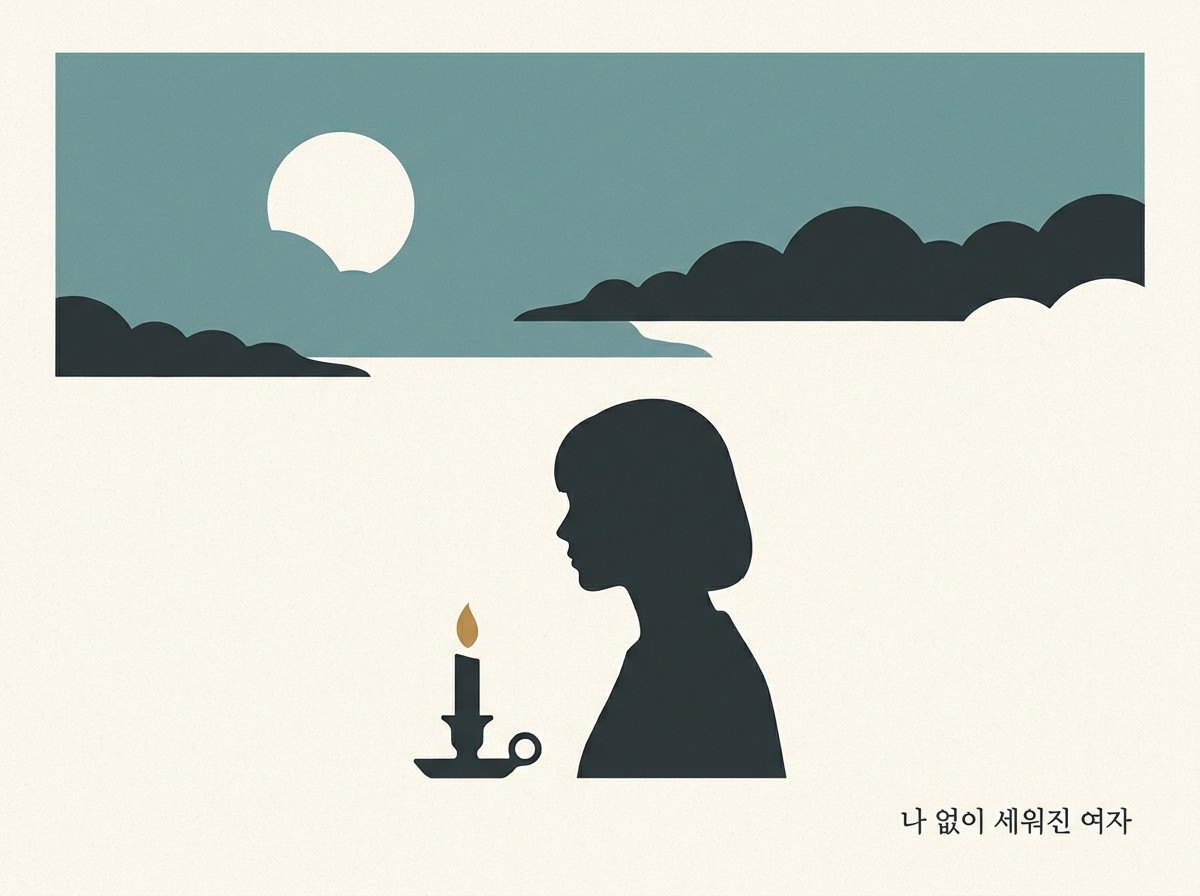
There is an old term in painting: 烘雲托月, hongyun-tuoyue—to paint the moon, do not paint the moon but the clouds around it. The moon rises from the place left unpainted. Rei’s ending is like that. Because whether the flame brightened to the end is left unpainted, the 我 remains, rather, as a sharper possibility. What would have stopped had it been fully drawn flows on because it was not. That dim place set at the beginning lays before us, for the first time and yet unclosed, the single question the whole work will end by asking and answering—whether to set up the “I” or to loosen it.