There is a scene one sometimes witnesses in a meeting room. Something has gone wrong, and when you trace it, no one is at fault. The rules were followed, the procedures kept; the luck was simply bad. Everyone is ready to file it that way and stand up, when one person speaks. I missed it, he says. No one had asked him to answer for it. Unasked, he takes it. The air in the room shifts by a degree. Everyone knows he loses by it. And yet, strangely, he is the only adult in the room.
In the previous essay I called Oedipus the man who could not escape. His excellence was the bait, the seat assigned the role — do not blame him, I concluded. After closing that piece, one scene would not fade. When the queen begged him to stop digging and the old herdsman begged, he did not stop. In that passage he was not being pushed. He could have stopped. He simply did not. One word changes: not that he could not escape, but that he did not.
The Hands That Lift the Burden — Freud and Jung
The first to set Oedipus free were Freud and Jung. They point at different places, but the gesture is the same. In Freud’s hands the prophecy folds from outside to inside: the first pull toward the mother and the first hatred of the father become the childhood of us all, and the oracle at Delphi a script written within him before he could know it. Jung reaches the same place by another road: the incestuous image is not lust but the drive back toward the source, and fate is the unlived portion returning from without, wearing an outer face.
In the previous essay these two readings were the starting point of a conclusion — that the fate was inside him after all. Here they serve another use. The moment the guilt becomes the unconscious’s doing, the return of an unlived portion, the conscious man steps back a pace. He did not do it on purpose; something in him, unknown to him, did it. The two men move Oedipus from the criminal’s seat to the patient’s — from a man to be punished to a man to be analyzed. To pity him, to tell him it was not he who did it: the greatest consolation psychoanalysis can offer lies there. And these are the first two letters of pardon he is about to hand back.
The Skipped Line — Yi Je-ma
In the previous essay I placed Yi Je-ma (李濟馬) on the side of those who set him free. If I have discernment, people gather; once they have gathered, I deceive — the seat assigns the role, and I built on that sentence. But writing that essay, I skipped a line. Between the line about gathering and the line about deceiving, Yi Je-ma had set one more.
雖有識見 若無信心.
Though one has discernment — if one lacks a trustworthy heart. The current runs not in two lines but in three. That excellence gathers people is necessity. That one ends by deceiving the gathered is, once the conditions are met, necessity too. But between the two stands a condition. The place where it could be cut was written into the sentence itself. So Yi Je-ma was never in the business of pardon to begin with. That the seat is laid is beyond your hands, he was saying — but between the seat and the ruin there is a hand’s breadth where you can stand, and he wrote it into the same maxim. The Yi Je-ma of my previous essay was a Yi Je-ma I had read by half. And that the line escaped my eye was, come to think of it, the very optics that essay described. To an eye hardened toward the seat, only the sentences about the seat are visible.
Elsewhere he drives the nail all the way in.
禍福無不自己求之.
There is no misfortune and no fortune that one has not called upon oneself — down to dying early or dying late, he adds. The sentence is the opposite of consolation. “You called it upon yourself” sounds cruel, and at the same time it means: I will not treat you as a child. Instead of lifting the burden, it acknowledges the burden’s owner.
The last movement of Oedipus takes place exactly on that hand’s breadth. The place where the queen begged and the herdsman begged was the place where it could be cut. He did not cut it. Up to this point he is a man who slid for want of that one line’s virtue. But Sophocles goes one step further. Having learned everything, holding in his hand the perfect innocence of not having known, he does not use it. The oracle said he would kill his father and lie with his mother; it never said put out your eyes. That penalty was written nowhere. The blank in the conditional sentence he fills with ruin, and even the ruin he signs as his own. Here is the most extreme image of calling one’s misfortune upon oneself.
Nor did Yi Je-ma think the calling ends after once. Returning again and again, losing again and again — not one round ever won. Had it been an expiation, one punishment and done, it would have been lighter. Responsibility is not so kind. It does not arrive.
With No Self Left to Shoulder It — Buddhism
The deepest pardon still remains. Freud consigned the guilt to the unconscious and Jung to fate, but both left standing the ‘he’ who bore it. Buddhism takes even that away. In body, in feeling, in thought, the old scriptures say, no ‘I’ is finally to be found. If the owner of the guilt is an empty name, whom would you punish? This is an exit one layer deeper than the other two — not moving the guilt outward but erasing its owner.
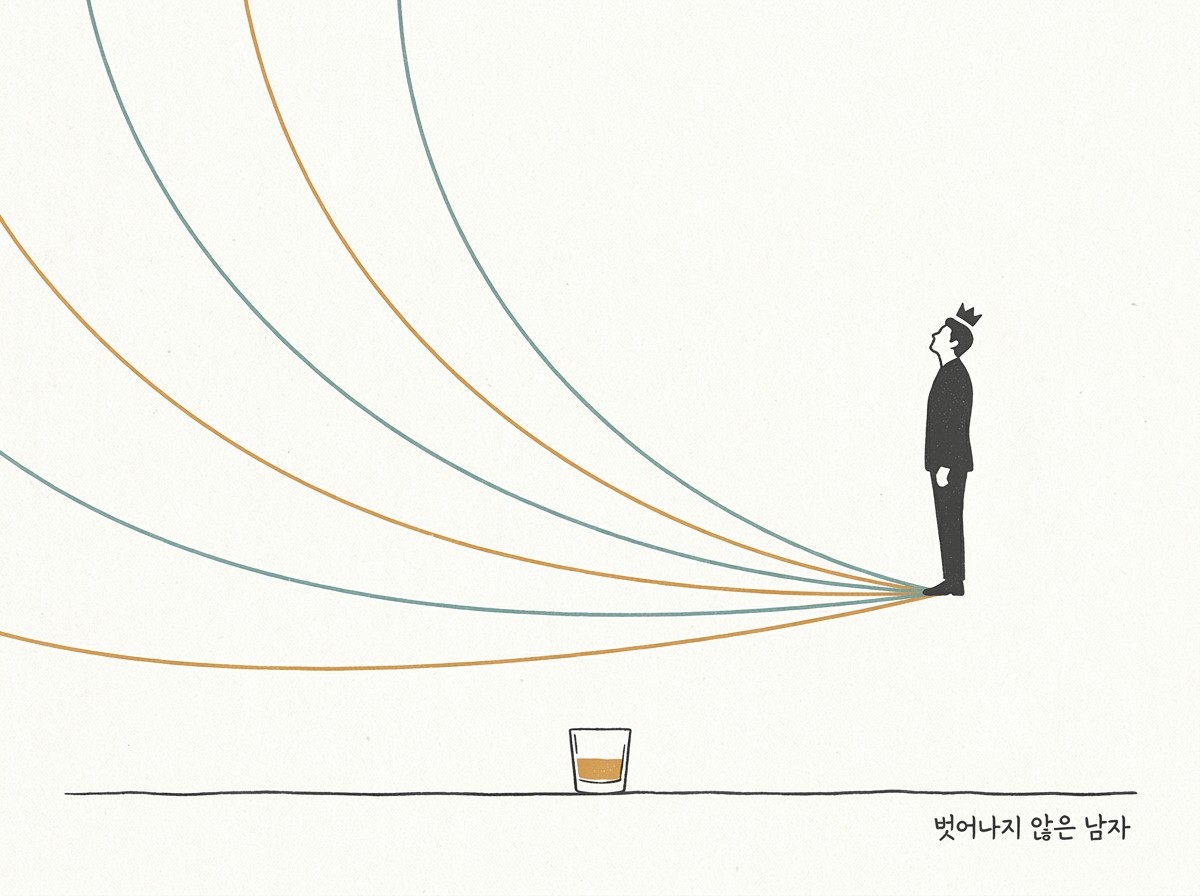
And he walks past this last exit too. At the door that says the ‘I’ is an empty name, he insists on standing that absent self up again in order to punish it. The self that cannot be grasped he seizes with both hands and sets the knife to it. Where he is told to lay it down, he grips harder. If you want to see how far responsibility can go, this is the place to look. Even at the point where there is no self left to shoulder anything, he does not stop shouldering.
The Eyes That Asked Outward
So the men peering into him end in an odd position. It was the unconscious; it was the unlived portion returning; there was never a self to answer for it — letters of pardon of different depths, and the man himself hands them back one by one. The most intelligent of men, seeing the exits better than anyone, declines to leave.
One last thing about his eyes. He was, all his life, a man who asked outward. Curious about his birth, he went to Delphi; curious about the plague, he sent to Delphi again; then he summoned the seer; then he summoned the herdsman. Even while the answer was pointing at him, the question kept facing out. Yi Je-ma, too, handled the eight trigrams — and did not divine with them. Rather than drawing outer fortunes from the figures, he set them aside as nothing but his own conjecture and turned the question inward: how clouded is my eye, now? Seen with that eye, the scene where Oedipus puts out his own eyes is the place where a lifetime of outward questions is cut off. What Delphi could not answer he asked, that day, for the first time, of himself — and charged the price of the question to himself.
I come back to the man in the meeting room. Most of us receive no oracles and put out no eyes. But to pry open what would have been easier left covered, and then to hold the result as one’s own and no one else’s — that is not rare. The moment when they tell you it was not your fault, that nothing could be done, and you do not take the words. It plainly makes a person’s life harder. But something comes into being only in that moment. In the place where he declines the pardon, a man becomes, at last, no one’s patient but himself. It is not the easier road. Only, sometimes, the uneasy side is the one way of standing as oneself — even if one need not go so far as the eyes.