I thought of this man again while boiling spaghetti. Waiting for water to come to a boil does not leave you much to do. Drop in the noodles, check the clock, watch the steam scatter toward the ceiling. Okada Toru started in exactly the same way—quit his job at a law firm, ironed his wife’s blouse, went looking for a missing cat, and stood wordlessly in front of a boiling pot. Murakami’s men usually stop right there. They lose something, endure that place for a long time, and the story closes with them unable to cross. Watanabe was like that. So was the unnamed narrator of Sputnik Sweetheart.
But Toru crossed. He climbed down to the bottom of a dry well in an abandoned house’s garden and sat in the darkness for days. At some point he passed through the wall and entered the room on the other side, and he kept walking all the way toward the wife who had disappeared. Jung would have recognized this at a glance—the person who, without quite meaning to, descends into a designated pit and finds light rising from that darkness; the process by which only someone who has passed through the darkest corner of themselves can move forward. In twenty-plus years of reading Murakami, I cannot think of another character who walks that diagram all the way to the end. For a while I planned to stop this essay there. The man who went down to the bottom and came back in one piece.
But that neatness caught me. When Jung fits this well, you have to be suspicious. Put the same man before other readers and see what they say. What would Freud say? What would the Buddha say? And what would Yi Je-ma—whom my work keeps making me turn to—say?
The Path Jung Opened, and the Emptiness at Its End
On Jung’s map, Toru comes close to a model student. He does not try to drag the forces of the unconscious out by force of will. What he does at the bottom of the well is simply wait. What Jung called the receptive attitude—not demanding by force what might happen next, but staying still and silent until the darkness speaks on its own terms. In the meantime his shadow takes shape: Wataya Noboru, his wife’s older brother. A man who captivates television audiences and the political world with smooth rhetoric—the exact opposite of everything Toru is.
When Toru climbs out of the well, a dark blue birthmark the size of a newborn’s palm has appeared on his right cheek. And in the mansion of the wealthy mother and son, Nutmeg and Cinnamon, he begins a strange practice: sitting in a dark room with swim goggles on, he lets women approach and touch and lick the birthmark. In those moments, he separates his consciousness from his body and makes himself an “empty house.” Through that emptied place, he receives the unnameable knots inside those women and dissolves them. A kind of healer. Jung would have seen the mana-personality here—the archetype of the shaman-healer that settles into someone who has passed through the unconscious. And he would have given an immediate warning: dangerous. The moment you mistake the power of the unconscious for your own, the ego swells into a hollow superhuman. The hero who retrieves the treasure from the abyss is swallowed by the monster the instant he identifies with that power.
Toru reaches that threshold. But he is not swallowed. At the end of the novel the birthmark vanishes without a trace. In Jung’s language: he completed the passage without being seized by the power. If individuation is the gathering of the world into oneself to become whole, Toru did it—up to here.
But the path ends empty. At the core of Jungian individuation is rescuing the anima—the interior feminine image—and integrating it into the self. That anima is Kumiko. Toru descended to the bottom of the well toward her. Yet Kumiko is not integrated. She does not return. Jung explains each stage Toru traversed, but he cannot explain why, at that very end, the anima departs with empty hands. The diagram was completed; the promised reward is absent. Toru walked the entire path and found no one at its end.
Freud Searched Toru’s Interior, but the Answer Is Not There
Freud erases the word “completion” to begin with. For him, Toru’s journey is not self-realization of any kind. It is energy that had been bound to a lost object being commanded by reality to withdraw, and a person who cannot release it all at once, clinging to each memory and peeling away from it in turn. Mourning is that—not moral completion but an exhausting, mechanical balancing of the accounts of energy. The long time in the well is not the tempering of a soul; it is the landscape of melancholia, where libido that found no exit withdrew inward into the ego and settled there.
And there is Noboru. For Freud, before being a brother-in-law, he is an older brother—the man who holds the sister. What a boy harbors toward the man in that position exceeds competition; it is a death wish. When Toru swings the bat in the darkness beyond the wall, Noboru simultaneously collapses in his office with a crushed skull. Jung called this the integration of the shadow; Freud says it more drily. Long-suppressed hatred and sadism simply found their direction at last. There is no redemption in this. Energy flowed from one side to the other; the ledger was settled that way. Toru did not become a better person. He paid a debt.
But Freud too hits a wall. He searches Toru’s interior thoroughly and then stops before the most important question. Why could Toru’s love—that marriage—not overcome Noboru’s hold on Kumiko? Even in marriage Kumiko could not escape her brother’s sphere. She slept with countless men without her husband’s knowledge, and later confessed it was because “my brother opened a drawer inside me and took something out.” Why was Toru’s bond weaker than that dark cord? Freud, having accounted for every drive in one person, cannot answer this question. Because the answer is not inside Toru. It is not a problem inside one person; it is a problem of the 場 (jang—relational field) laid between two people.
Buddha Sees From Too Far Away
Here it is worth pausing to hear a different voice. The Buddha would have stepped back from all of this and looked at it from a distance.
Toru believed he descended in order to “find Kumiko.” But finding Kumiko was ultimately finding himself. The 楞嚴經 (Śūraṃgama Sūtra, Neungeomgyeong—a Mahāyāna Buddhist text) contains the story of Yanajdatta (演若達多, Yeon-ya-dal-da). One day, looking in a mirror, he became convinced his head had disappeared and went mad, wandering the streets in search of it. But his head had never disappeared at all. He had only raved in confusion, mistaking an illusion for his own lost head. If there is no “self” to find in the first place and yet one sets out to find it, then the well Toru passed through, and the wall, and all of it, become phantom flowers glimpsed by exhausted eyes in empty air. The women’s inner knots he healed, the power of the “empty house” with which he dissolved them—nothing but forms without substance. More piercing still: the very method by which he wielded that power was to empty himself—to practice 無我 (mua; Sanskrit: anattā—non-self). He spent so much effort searching for his “I,” yet his capacity only emerged when he emptied that “I” out.
This is a sharp blade. But it is swung from too far away. If everything is illusion, then Noboru’s ferocious violence and Toru’s quiet endurance are the same illusion, and the difference between Kumiko hardening and Toru not hardening dissolves into 空 (gong; Sanskrit: śūnyatā—emptiness). Yet that difference is the most important thing in this story. The Buddha’s eye is too high to catch it. So we cannot stay there long. One cold cut, and then back down to earth.
Yi Je-ma — From the Place Without Victim or Perpetrator
What Freud could not solve, what the Buddha dissolved, Yi Je-ma receives. It may sound strange, but the writings of this physician who examined human nature in nineteenth-century Hamgyeong Province reach most deeply into the dry well in Tokyo.
Open the 格致藁 (Gyeokchigo—Yi Je-ma’s collected philosophical writings) and three layers of flow emerge: 局 (guk—the innate disposition shaped into each person’s constitution), 場 (jang—the relational space that arises when two 局 collide), and 面 (myeon—the living membrane where the two meet and constantly reshape each other). In Yi Je-ma’s world there are no solids. People and relationships all flow. His most frightening statement is this: evil is not a substance; it is 凝固 (eunggo—congealment, solidification). No one is born bad in particular; rather, when the same water flows and pools in one place and hardens there, that hardening is called 鄙薄貪懦 (bibaktamna—meanness, shallowness, greed, and cowardice). In the mountains it is a spring; at the riverbank it is river water; in the sea it is seawater—only the names differ, the water is the same.
Through this lens, Noboru and Toru are mirror images. The two share one woman—one as sister, one as wife. Socially, one rises to the apex while the other descends to the bottom. One captivates the world with words; the other enters a well in silence. One puffs upward and the other sinks downward. And decisively, both possess the power to enter another person’s interior. Noboru enters and takes something out (as if opening a drawer in Kumiko), while Toru makes himself an empty house to receive and dissolve. Positive and negative of the same ability. On every axis, the two stand precisely facing each other. The mirror reflecting both means they are made of the same material. The difference is not essence but direction. On the same 場, Noboru rode that power and hardened, while Toru did not harden.
The 팔괘잠 (八卦箴, Palgwaejam—Eight Trigram Admonitions) in the 格致藁 contains this passage: 我有强力人必趁我我必行奪, “When I have 强力 (gangyeok, forceful power), people will inevitably pursue me—and from that position I will inevitably move toward taking.” The word inevitably (必) appears twice in every clause. Not a question of morality but structural necessity. No one is born to the bad role; rather, the position assigns it. Noboru is a 局 that rode that power and hardened, and a hardened 局’s 안공 (眼孔, angong—capacity for clear discerning sight) cannot see people as people; it can only see them as roles. And so he grafts onto Kumiko the role that his dead sister vacated by suicide. Like a hardened woodblock reprinting the same surface endlessly.
Here we want to condemn Noboru. We want to pity Kumiko. But 格致藁 stops that hand. There is no separate victim and perpetrator. Yi Je-ma did not write about 鄙薄貪懦 as other people’s business. He is the man who wrote of himself: “From youth to old age, the deceiving mind never ceased.” He threw himself into that flowing water too. Noboru, Kumiko, and Toru are all the same water standing on the same 場. To stop judging who is cleaner and who is dirtier, and instead to see where the water pools and where it flows—that is the way of seeing this physician taught.
Do Not Fight the Jang (場)
Did Kumiko, then, by killing Noboru, escape that relentless 場?
She did not. This is the coldest truth in this story. The 場 is not the person named Noboru. Noboru is only one 面 that solidified and surfaced out of that 場. Break one 面 and the 場 does not disappear. Looking more deeply: the very act of Kumiko killing him is already happening inside the 場. She goes to kill Noboru, and she sends her farewell message from none other than his office computer. To the very end, she is within his place. And where she goes after the killing is not freedom—it is prison. She has moved from one confinement to another. She refuses visits and refuses release and says she will stay quietly inside.
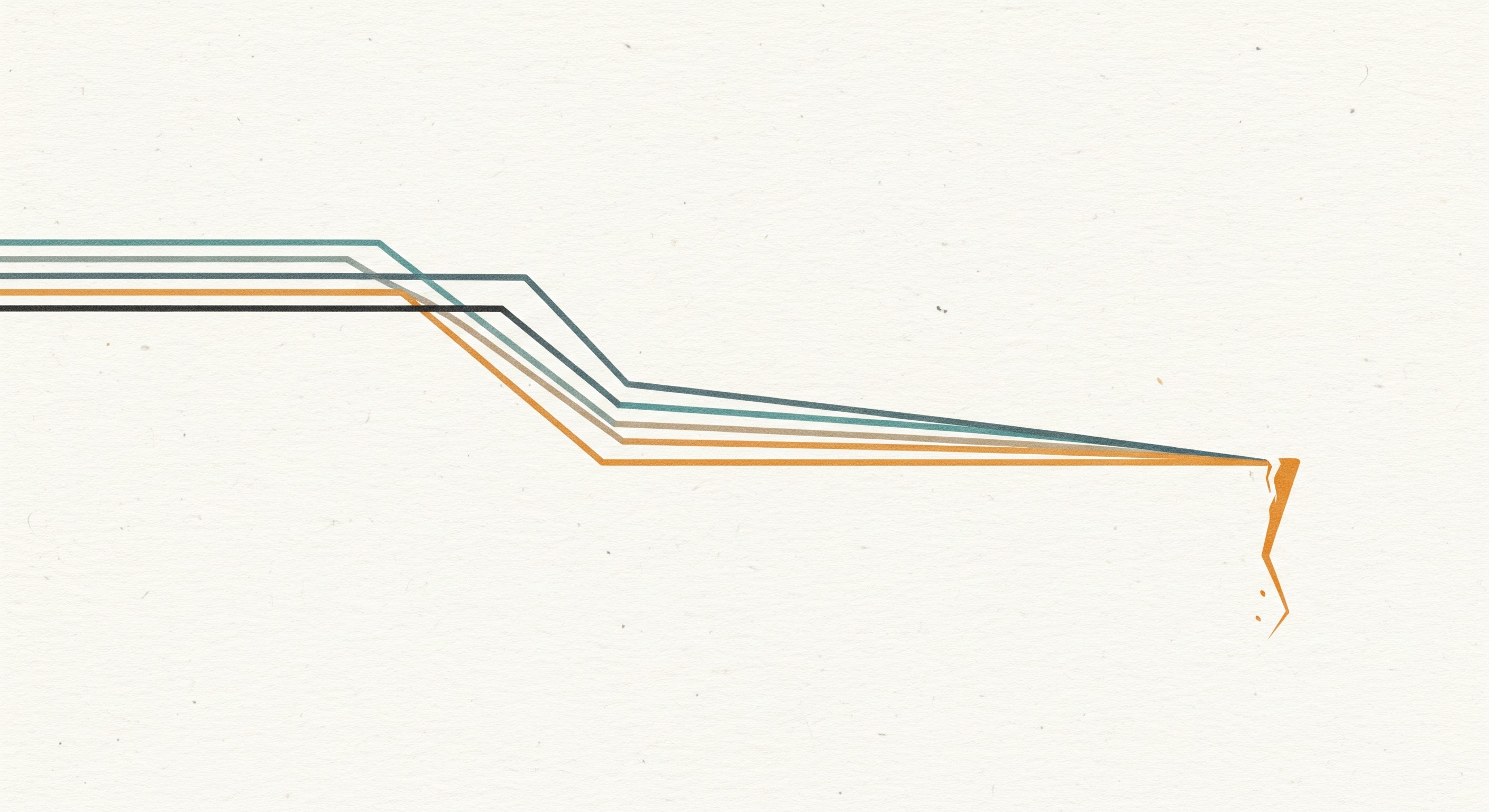
Through 格致藁’s eyes, the killing is not a path out of the 場 but the deepest proof of having been consumed by it. The way to survive the 場 is not to break a 面—that is only another 行詐 (haengsa, deceptive action)—but to surface in a different form before hardening. Yi Je-ma called this 反誠 (banseong)—not reversing course to become good again, but quietly evaporating into a different form, like steam, just before hardening. No destination; returning to the starting point each time; a movement that never stops. Kumiko could not evaporate. She returned to Noboru the violence the 場 had given her, in the 場’s own grammar. Just as Noboru grafted onto her the role his dead sister had vacated, she inherits Noboru’s violence and uses it to kill him. Break the mirror and the reflected image does not disappear. Only the person who broke it comes to resemble that image.
Toru took a different path. He did not fight the 場. He did not go to confront Noboru directly and break him. He sat still at the bottom of the well, emptied himself into an empty house, and passed through without losing his 안공 (眼孔, capacity for clear sight). Even the moment he swings the bat through the wall—it was less an active attack than an event through which the 場 itself flowed. Because he had not hardened, he was not seized by the power. Even as he took on the role of healer, he kept himself emptied so that the role could not harden him. Because he did not try to possess the birthmark, when the place closed the birthmark walked out of its own accord. Exactly the survival principles of 局·場·面 that Yi Je-ma described: appear to assimilate while not being absorbed (安恭, angong); recognize that the moment of apparent victory is most dangerous and do not harden there (勿忘勿助長, mulmanmullojanng—neither forget nor force growth); keep one’s presence low to survive (不得已, budeukyi—only when unavoidable). Toru did not win against the 場. He simply slipped out of it without hardening.
Not Having Hardened — That One Thing
There is no salvation in this story. No one was rescued; no one rescued anyone.
Kumiko was not redeemed through Toru. The marriage did not pull her free of her brother’s orbit; in the end it was not Toru’s hand but her own that cut the knot, and that hand took her not to freedom but to prison. Toru descended to the bottom of the well and rescued no one. He walked every stage Jung drew, but at the end the anima left without being integrated. No treasure remains in his hand. No birthmark, no power, no wife.
Noboru, Kumiko, and Toru were all the same water standing on the same 場, flowing in different directions. Kumiko fought the 場—by killing her brother—and hardened deeper into confinement. Noboru had already hardened long before, riding the power of the 場. Toru did not fight. He emptied himself and flowed out without hardening. He did not win. He only survived.
The novel’s final scene is not a reunion, not the completion of revenge, not the light of enlightenment. Toru meets Kasahara May and parts from her, boards a train, and in a place far from anywhere and anyone, sleeps for a very brief moment. The 場 remains exactly as it was. The birthmark came and went of its own accord. His hands hold nothing. What he has is one thing only: he did not harden. He decides to return to the empty house and wait for Kumiko, and in his mind he gives a name to the child not yet born. Corsica.
Perhaps what a person can do within the 場 is not to win. Not to become a good person and vanquish evil, not to see through all things as illusion and achieve detachment. Only this: not to harden. Rather than breaking one 面 by fighting and hardening deeper in the process, to protect oneself while remaining flexible—surfacing again in a different form before each hardening, and surviving that way. What that ordinary man who stood wordlessly before a boiling pot finally showed us was that one thing. I do not think it is a small thing.