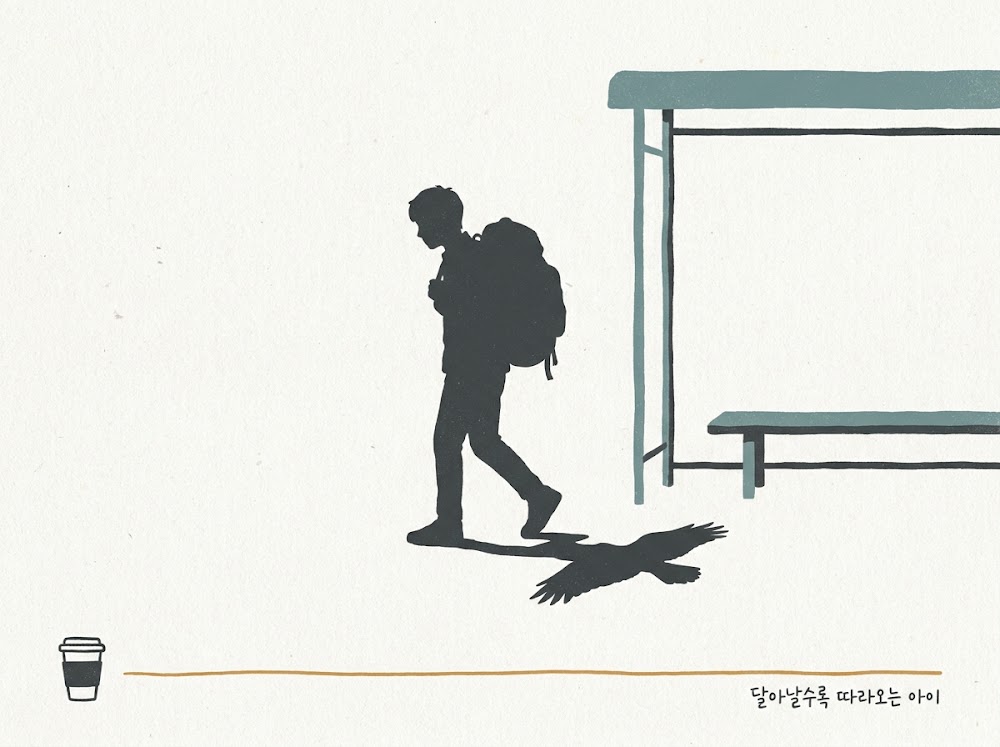
I once saw a boy at a bus stop late at night, carrying a backpack larger than himself. Fifteen, maybe sixteen. The pack was so heavy he couldn’t get it on in a single motion—he balanced it on his knee, then swung it up onto his back. His hands worked the straps with a practiced sureness. Anyone could see it held the weight of a long journey, yet his face strained to look as untroubled as someone out for a walk. That strained blankness stayed with me for a long time.
We tend to think running away means going far. But what a runaway child truly fears is often not the home left behind, but something packed into the bag along with everything else. However far he goes, it stays on his back, the same weight as before.
Kafka Tamura leaves home on his fifteenth birthday. He leaves from a single sentence his father drove into him long ago—you will kill your father, and you will lie with your mother and your sister. His mother vanished when he was four, taking only his sister with her. So the boy departs carrying two burdens: a farewell he never received, and a curse he received before he was old enough to take it.
In my clinic I often see people who carry something heavy on their backs while wearing untroubled faces. That is why this boy did not feel like a stranger to me. I looked at him for a long time.
If Freud Were Reading—The Shadow That Goes by the Name of Fate
Freud would not have seen this prophecy as an arrow flown in from outside. Somewhere in the Standard Edition he wrote that Oedipus Rex holds us not because its oracle is cruel, but because that oracle touches something that was already within us. Fate, that lofty word, is the shadow cast outward by a wish the unconscious cannot bring itself to claim as its own. He wrote, too, that perhaps all of us once directed our first love toward our mother and our first hatred toward our father. Oedipus is not someone else’s story; it merely shows us our own childhood wishes realized upon a stage.
Read that way, you begin to see why a curse handed down by a father clings so tightly. Not because it is purely an outside punishment, but because it resonates with something the boy already carries. This is why Kafka, in fleeing, seems to be fleeing not his father but himself. What follows him the farther he runs is the thing on his back, which turns out to be inside him all along. The faster his feet, the closer the shadow presses.
The loss at four leaves another mark. When a loved object disappears, the love that reached toward it is drawn back inward, and the child identifies with the one who left, setting that person up again inside himself. Freud called this the shadow of the object falling upon the ego. The mother’s absence lodges permanently in one corner of the self. And so the melancholy that grows in that spot arrives wearing not the face of grief but the face of self-reproach—that strange arithmetic in which the one who left is the other, yet the one found wanting is the self.
The scene in which Kafka commands himself to become the toughest fifteen-year-old in the world is, then, not a story about strength. A boy who has only ever been left behind is now staging, with his own hands, a leaving. Like that small child Freud watched for so long—the one who threw a spool away and pulled it back, rehearsing alone his mother’s disappearance and return—Kafka shoulders his bag to move from the seat of the one who is left to the seat of the one who leaves. Those practiced hands tightening the straps, expressionless, are here. He is not trying to be strong. He is trying to never be left again.
If Jung Were Reading—The Crow, a Second Voice
Kafka has within him a boy called Crow. A voice that appears at every decisive moment to push him on, to hold him down, to tell him to grow harder. On first reading it looks like nothing more than an imaginary friend, but Jung would have called it something else: an autonomous complex. A second personality, split off and behaving as though it possessed a will of its own, beyond the control of the ego.
Writing of a boy who had stabbed his sister, Jung described the apparition that came to lay the blame on him as the symbol of a second self that drove him to ruin. The dark, inferior part pushed out from the bright side of the ego—what he called the shadow—grows when it takes on the heat of emotion and becomes a separate voice. Kafka’s Crow is that shadow given a mouth. What is striking is that Crow does not always play the villain. He pushes, but he also protects. As Jung warned again and again, a person who pretends not to see his shadow is gravely harmed, within and without. That Kafka does not collapse may be because he did not turn his back on that dark voice but carried it with him.
And there is the forest. At a certain point in the story Kafka walks into a deep wood and crosses the edge of this world. Jung would not have seen this as merely getting lost. He spoke of such a descent not as an aimless fall but as a going-down into a meaningful cave—a kind of crossing of the night sea, in which the mind’s energy, sunk as though dead, wakes anew in that darkness. The things Kafka meets in the forest—a village where time has stopped, the figures of those who have left—are less an outer landscape than the landscape seen by a man who has gone down into himself.
At the end of that descent is what Jung called individuation. He described it not as some grand completion but simply as becoming oneself. And that process, he wrote, without exception begins with facing one’s own shadow. When Kafka comes back out of the forest, nothing has been resolved. But he has, once, sat down face to face with the dark voice inside him, and the person after that sitting is, by some faint measure, not the person he was before.
If We Read Through Sasang Simhak—A Mind Boiled Over
Yi Je-ma (李濟馬) wrote that when the mind runs to one extreme it cuts the body. 哀極不濟則忿怒激外, when grief fills to the brim and finds no release, it bursts outward as rage. A mind once shaken that violently, he said, is like a blade drawn once across the organs: ten years may pass and it will not heal. 一次大動 十年難復. If a boy who lost his mother at four, the grief finding no place to be released, grew up covering it over with blankness and hardness, then in Yi Je-ma’s eyes that hardness was not health but the scab over a wound already cut deep.
Another thing Yi Je-ma raised stays with me. He held that before the self has ripened, things such as a father’s mental influence or the values of an age deform the immature mind and body. The single sentence driven into Kafka is exactly this. Before he could decide the shape of his own mind, one line from his father entered first and hardened the boy’s mind in one direction.
Kafka all but lives in the library. He is a boy who holds himself up with thought. In the language of Sasang Simhak, he leans on 識見, singyeon—insight, the clarity of knowing. But for a boy whose experience of being deprived came too early, that leaning often becomes the other face of a deprived mind—奪心, talsim. As though he must know everything in advance so as never to be robbed again, he tries to grip the world hard with his head. The scene in which Crow rises from the place of the boiling mind and pushes him is not far from the state Yi Je-ma saw, in which the mind boils over and is swayed by some second thing. This is not a matter of pinning down a constitution. But that this boy’s hardness is not an inborn strength but a straining not to be robbed—that much seems clear.
And Yet—Did All of This Happen Inside the Boy?
The three lenses to this point converge on a single point. The curse is, in the end, his. Freud’s unconscious, Jung’s shadow, Yi Je-ma’s mind boiled over—all three point to work Kafka must do within. Face the shadow, settle the robbed mind, see the wish inside you. All of it true.
And yet, once you have seen this boy—abandoned at four, cursed in advance—only within that plane, one thing keeps catching. The curse is not something Kafka made. He was four when his mother left him behind. He was an age that could choose no words at all when his father drove in that sentence. So to say “it is a matter inside you, so you must resolve it” feels like an invoice handed to the wrong person. The place that hardened was made by the 場, jang—the field where one configuration collides with another—yet the task of melting it is shouldered by the boy alone.
Yi Je-ma sees the same place differently. He wrote that a person who possesses insight draws others to him, and so the role of the deceiver falls to him: 我有識見 人必歸我 我必行欺, I have insight; people necessarily gather to me; I necessarily come to deceive. In each line the character 必—“necessarily”—is driven in twice. This is not a moral judgment but a pointing at structural inevitability. Not that some people are simply bad, but that a position assigns a bad role. The role that fell to Kafka—that he would kill his father and violate his mother—did not grow from the boy’s nature either. It was allotted to him by the place where he stood.
Yi Je-ma’s metaphor of water comes alive here. The same water is called spring water in the mountains, river water by the riverbank, sea water where it meets the sea. The name is not the water’s nature but a designation of the place the water now occupies. So it is with the name cursed child fastened to Kafka. It is not his seed, but only the name of the place where the position called father and the position called vanished mother have hardened him for a time. That evil is not a substance but a hardening means, too, that one cannot blame the boy alone while leaving out the hands that did the hardening.
Turning Back
Where, then, is the way to be saved? Yi Je-ma does not answer the question of changing the position itself. That lies outside his book. The father cannot be made into someone who never was; the farewell at four cannot be taken back. The 場 cannot be changed.
What he left is something else. At the very instant the deceiving mind rises and is about to flow into actual deceit—lifting away, in that fraction of a moment, into another phase. Not turning back on the road, but rising up from it for a moment. He called this 反誠, banseong—not a return to virtue but a lifting into another phase, lost again and recovered again, each time. There is no won match, no reached end. Only the work of shifting that incline, once more, in every moment.
This is why the scene of Kafka walking back out of the forest stays with me so long. He won nothing. The curse was not lifted, and the vanished mother did not return. But he decides to go back. Crow tells him to sleep, and he sleeps. Nothing has been resolved, yet that one act of going back is strangely solid. The kind of solidity that, having no point of arrival, begins anew each time instead.
The boy at the night bus stop got on the bus in the end. The backpack was as heavy as ever, and his face was still pretending nothing was wrong. I don’t know where he went. But that day I saw, dimly, that there is also such a thing as taking a step not by lightening the load but while still carrying it. What Kafka did was probably something like that. Not finally setting down what was on his back, but turning around while still carrying it.