Some memories ignore duration. That something which lasted perhaps ten seconds can come to occupy forty years—I find that strange sometimes. Time that stays long tends to blur and fade, while what remains vivid is usually brief and unremarkable: an empty hallway after someone left and closed the door, a tea cup gone cold, a hand taken and released without a word. Such scenes have no thickness, yet they are heavy. Perhaps they are heavier because they have no thickness.
Kawana Tengo is a man who carries one such scene for a lifetime—two, to be exact. One is a scene he believes he saw when he was a year and a half old. The other is something that happened in an empty classroom when he was ten. He has a large body, teaches mathematics, and wants to write novels. On the surface he appears calm and settled. But whenever those two scenes ambush him, he stops in the middle of whatever he is doing. His breathing shortens. For a moment he loses track of where he is standing. I have seen that kind of stopping outside the clinic too—people talking normally until some word empties their expression without warning. When I start wondering where that emptiness comes from, I have a habit of picking up a few books and opening them in sequence.
Freud would have gone to Tengo’s first scene first. The brief image a year-and-a-half-old child saw: a woman who was his mother offering her breast to a man who was not his father. What Freud would have found interesting is not whether this actually happened. It is that such a young child could have had no idea at the time what the scene meant, yet it remained lodged somewhere in the body without disappearing, then took effect long afterward. He called this Nachträglichkeit—deferred action. The childhood trauma operates belatedly, as if it had just occurred, but does so unconsciously. In one case study he wrote: the impression received at a year and a half is something the child cannot properly respond to; the comprehension and the shock come much later, and the conscious grasp later still. Between the moment Tengo “saw” that image and the moment it paralyzes him, there are decades of lag.
And the image is unusually vivid. Tengo recalls that scene with a clarity that feels almost unreal. Freud was suspicious of exactly this kind of excessive sharpness. When repressed memory exists, what surfaces to consciousness is often not the memory itself but an adjacent image—trivial, yet strangely distinct. He noted that patients recalled scenes with uncanny sharpness that turned out not to be the core of the event but its peripheral detail. The real thing is concealed elsewhere; in front of it stands a sharply rendered screen. The single frame Tengo has looked at all his life may be just such a screen—a vivid substitute for something he could not bring himself to see directly.
The question is what that one frame made of him. Tengo is someone who gets carried by the current. When an editor proposes ghostwriting, he hesitates and then goes along. His older girlfriend sets the day and the manner of their meetings, and he keeps them. The large decisions in his life he largely lets others roll along for him. Freud would have read this not as laziness but as cost. Too much energy is spent pressing down the lodged trauma, leaving not enough for the business of living. The trauma keeps operating like a foreign object even after it has entered, he said—and so people remain bound to their traumas. Someone bound this way quietly withdraws from reality. He wrote that even a mild neurosis distorts a person’s relation to reality, and in severe cases it becomes a flight from actual life. The way Tengo slides so naturally into 1Q84—the world where two moons hang in the sky—makes a strange kind of sense because of this. A person not firmly anchored to reality has a low threshold for crossing into another world.
Jung would have looked at the same mother from a different angle. Where Freud saw the mother as the source of the trauma, Jung saw the emptiness she left. For Tengo, the mother is said to have died, yet she is absent and at the same time immensely present. Jung held that the first carrier of a man’s soul-image is always his mother, and that it is later taken up by the women who move him emotionally. When the mother disappears early, that place is left unfilled inside him, and it keeps pulling his libido backward. One of Jung’s sentences points almost exactly at Tengo: if a man remains bound to his mother, the life he should have lived flees into conscious and unconscious fantasy. Tengo does not live real life; he lives a novel—and ultimately another world entirely. That is not laziness but another form of a life that has fled.
Into that empty maternal place Tengo installs two women. The uncannily vivid girl Fuka-Eri, and Aomame, whom he has not seen since they were ten. Jung would have called this anima projection—a man casts his own feminine unconscious onto real women, and is bound to them because they reflect back his own unreached depths. That Tengo cannot forget a girl whose hand he held once, across twenty years, may be because that hand is not quite Aomame the person but Tengo’s own lost half. And Jung would have asked one thing more. The way Tengo, in the act of ghostwriting Fuka-Eri’s story, gradually descends into a dark other world—Jung would have read this as the encounter with the shadow. The shadow is not absolute evil but simply the less adapted, more immature, more ungainly aspects of oneself; to become whole, he wrote, one must also come to own the darker side. Tengo entered someone else’s story and, in doing so, descended into his own interior.
Jung’s story has an ending. The destination of all this is individuation—the gathering of scattered pieces into one person. Tengo is carried along throughout the novel, but at the end he makes exactly one choice himself. He follows the memory of a hand to find Aomame, and walks out of that world with her. Jung would have called this the withdrawal of the anima projection—the moment when a life that had been bound to the mother and fled into fantasy at last returns to its own body.
Here I pull out another book I regularly use: Yi Je-ma. Placed within his framework for human types, Tengo belongs to the kind whose head runs furthest ahead. The power to penetrate and organize things logically stands at the very front; the gift for holding the structures of mathematics and narrative together in one hand comes from there. Yi Je-ma held that for exactly this kind of person, the function at the opposite end—感情 (gamjeong, relational feeling)—is the last to mature and the most clumsy. Tengo fits exactly. He goes deeper than anyone in comprehension and attentiveness, but in moving that comprehension into words, expressions, warmth that actually reaches another person—he is always one beat late, or blocked entirely. His paralysis is not that his mind stops. It is that the mind alone remains while the feeling does not follow. This is why, for all his teaching and writing and keeping his fixed weekly relationship, he never quite reaches anyone. He is not someone hidden inside himself but someone in whom only the one softest place stays perpetually shut.
Yi Je-ma would have noted one thing more. Such a person fills the gap by drawing on an ability from far away. In Tengo’s case, that is the eye that sees far ahead and deep below. Unable to handle immediate feeling, he sustains himself with insight that penetrates to the far horizon and to the bottom of things. Yi Je-ma wrote that the borrowed position comes with a shadow attached—the desire to grip as one’s own what is not one’s own. There Tengo’s heart lives: the heart that holds the one hand grasped long ago and will not release it for forty years. And what Yi Je-ma saw as this person’s lifelong task was 흔들림—wavering, the restless inability to settle, the mind that always doubts where it stands. Tengo’s stopping in the middle of the street, losing track of where he is—that is exactly it. Yi Je-ma too, then, like Jung, would have pushed Tengo in the same direction: his recovery lies in finally bringing that blocked feeling alive in his own body.
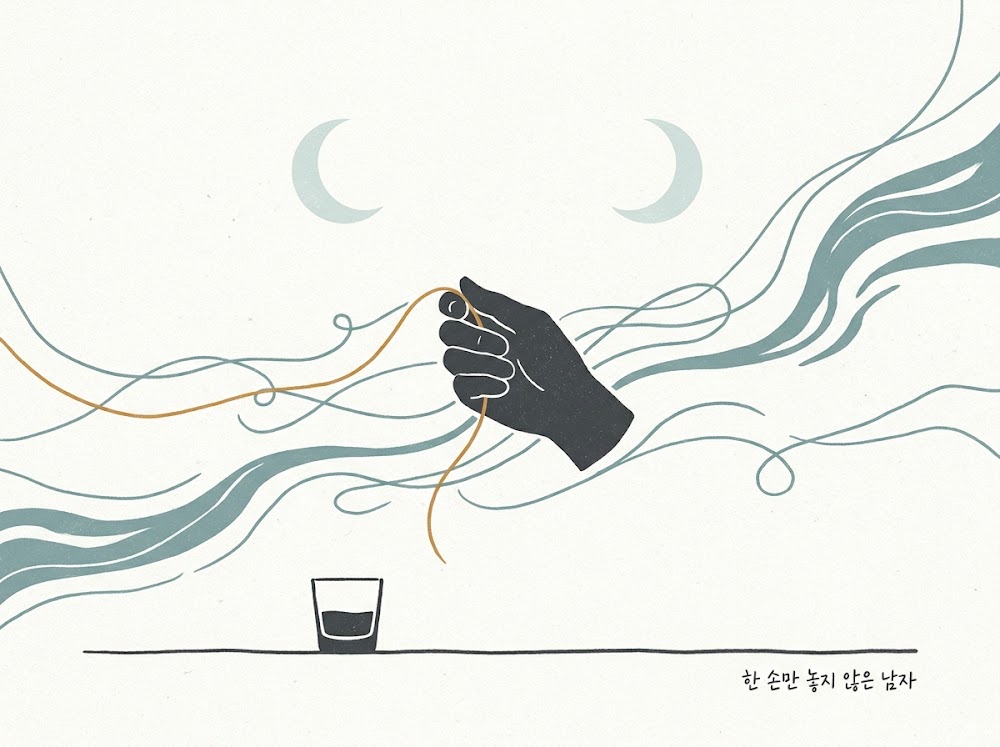
But open the fourth book and the story divides. Buddhism. The heart that refuses to release one hand for forty years—the Āgama discourses (阿含經, early canonical Buddhist sutras compiled in the Chinese tradition) give it a different name: 渴愛 (tanha—craving, or thirst). One sutra calls craving a net, and glue, and a wellspring, and a lotus root. It covers and binds all beings, dragging them from this world to the next, giving them not a moment’s rest. Tengo’s hand is like that. The memory does not let him settle in one place; it keeps him longing without end, pulling him across an entire life toward someone he has never been able to reach. Another sutra goes further, urging the severing of desire, of clinging to views, of attachment to self. Buddhism’s prescription is unambiguous: release that hand.
This is where two currents collide head-on. On one side, Freud and Buddhism: that hand binds you—it is trauma, it is craving—and you must let it go. On the other side, Jung and Yi Je-ma: that hand is your lost half and a bridge to cross by holding on, so hold it to the end and follow it. One and the same frame, and one side says release while the other says hold. Tengo himself chose which side. He did not let go. The man who had let everything else be carried along by the current kept only that one hand clenched to the very end, followed it into another world, and came back together with her.
And so these four books do not converge to a single point. They seem about to converge, then split at the last moment. But before the split, in one thing all four say the same thing, with near-uniform voice: that Tengo is passive. Freud called it paralysis from energy drained by trauma. Jung called it a state in which his life, bound to the mother, had fled into fantasy. Yi Je-ma called it the place where the one softest feeling-capacity stayed perpetually unopened. Buddhism called it the shape of a man dragged by the net of craving. The diagnosis converges. Only in what to do with him does the path diverge.
Perhaps that is why Tengo is a character who endures. Throughout a life of being carried along, he refused to release only one thing—and that one thing both bound him and carried him across. The binding and the crossing were the same hand. None of the four books can explain this alone. The book that says let go cannot account for the fact that he held on and came back alive. The book that says hold on takes too lightly the weight that one hand placed on forty years of stopping.
When I close the clinic door and step outside, I sometimes think about that empty classroom. Ten seconds in a room with no one else—someone wordlessly taking a hand and releasing it. If those ten seconds come to occupy an entire lifetime, is that illness, or is it salvation? I still cannot answer it either way. But when I face someone who carries a hand like that, I find myself thinking it is better neither to make them release it too quickly nor to have them grip it too hard. Some hands bind while they carry you across. Tengo was the man who held one to the very end.