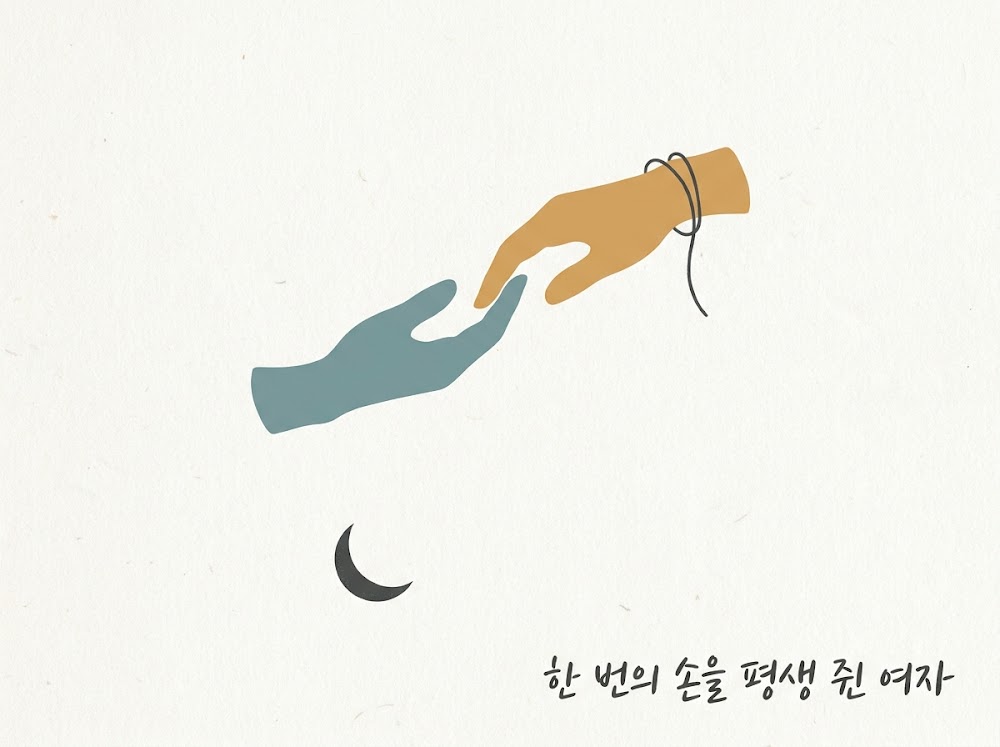
I sometimes think about holding hands. The time it takes for two people to clasp hands is, at most, a few seconds. A handshake: two or three pumps, then release. A parent grips a child’s hand only long enough to cross the street. Most handholding is brief, and because it is brief, it is forgotten. Yet on rare occasions—strangely, impossibly rare—a single act of holding hands determines the entire arc of a person’s life. A few seconds come to govern decades. It seems unlikely. But reading Haruki Murakami’s 1Q84, you watch one woman show you exactly how this is possible.
Aomame. A contract killer who silently eliminates men who have abused women. Everything about her traces back to one afternoon in elementary school, in an empty classroom after the last bell. A poor boy named Tengo takes her hand. That is all. Barely a word passes between them. They will spend the next twenty years apart. Yet Aomame never releases those few seconds. No one else’s hand can fill that place.
Freud would have called this scene Nachträglichkeit—deferred action. At ten years old, nothing actually happened. Two children held hands. The true weight of the moment did not stir until long afterward. Somewhere in the Standard Edition, he notes that a childhood scene can leave nearly no effect at the time, lingering instead as an unconscious trace, then awaken years later and operate as if it were a contemporary event. He was reading the Wolf Man that way. The difference is that his original scene was a catastrophic primal wound, while Aomame’s is its opposite. For her, that clasp is not a trauma but the original scene of rescue. It ignites backward across a lifetime, reorganizing the entire person around a single point.
The problem is the manner of holding. When a lost object is gripped too tightly, the mind cannot transfer it to someone new; instead it draws that object inward and identifies with it. Freud, writing on melancholia, put it this way: the shadow of the object falls on the ego. Aomame fits precisely. But there is a strange twist. She never lost Tengo. She never properly had him to begin with. What she mourns across twenty years is someone who was never her lover. This is why the mourning cannot end. To end, it would need to have begun with a loss—and since there was nothing to lose, it cannot. Her very identity solidifies around the absence of Tengo as its core.
Then what are all those killings? Freud, watching a child throw a spool away and pull it back, observed that people repeat experiences of helplessness not as memory but as action—moving from the passive position to the active, trying to master what once overwhelmed them. Aomame stood helpless before the death of her friend Tamaki, helpless before the death of another woman. That helplessness she inverts: she steps into the position of the one who eliminates. The destructive force that might have turned inward is redirected outward, and so instead of collapsing she picks up a tool. Only once, at the novel’s end, does she place the gun in her own mouth—and the possibility of finding Tengo again is what stops her finger.
Open Jung and a different image overlaps. Tengo is the masculine image that Aomame has carried inside her throughout her life: the animus. Jung observed that a woman’s animus typically takes the form not of a single figure but of a parliament of authority voices, an assembly gathered from many. Yet Aomame’s is peculiarly singular—frozen into the hand of one ten-year-old boy, solid as a crystal. What first occupied that position was the rigid authority of the Jehovah’s Witnesses, her father’s unbending truth. When she broke free from that hardened doctrine, she transferred the entire weight of it to Tengo alone and left it there, frozen.
Her descent from the world of 1984 into 1Q84 also reads in Jungian terms. The descent down the highway emergency stairs is a night-sea journey—a sinking from the surface of consciousness into deeper, more ancient strata. It looks like a terrifying regression, but for Jung such submersion is an inevitable passage toward rebirth. Two moons appear in the sky. The fracture between consciousness and unconscious has become visible, externalized into shape. Jung noted that the moon has always carried both its bright face and its dark face together. The small, misshapen green second moon is the unconscious split off and made real. And her capacity for killing is the shadow—the part of herself she carries without projecting it onto others. In precisely that way, she is paradoxically someone who has faced her own darkness directly.
Here I want to place one more lens across the text: Yi Je-ma’s 四象心學 (Sasang Simhak—the psycho-ethical dimension of four-constitution medicine, which maps distinct psychological tendencies and capacities onto four constitutional types). What strikes you first about Aomame is the near-total absence of joy (喜, hui) and pleasure (樂, rak). Twenty years of asceticism. A life without laughter. An interior stripped down to targets to eliminate and one person to wait for. The empty space is filled entirely with anger (怒, no) and grief (哀, ae). Yi Je-ma held that grief and anger as energies tend to rise upward, while joy and pleasure tend to settle downward. Aomame is someone who has spent a lifetime rising and hardening upward, without ever learning to descend and release.
This is someone Yi Je-ma would most likely read as 太陽人 (taeyang-in—the Greater Yang constitution), in the register dominated by grief and anger. He wrote of this type that grief (哀) disperses outward toward the distant and abstract, while anger (怒) is immediate and urgent. Both registers are present in Aomame: a diffuse sorrow aimed at the collective suffering of women, and a grief that collapses into acute urgency before a single friend’s death. What comes next is more interesting still. Sasang Simhak maps four psychic capacities onto each constitutional type: intuition (直觀, jikgwan), relational feeling (感情, gamjeong), cognition, and sensation. For the Taeyang type, intuition comes first and relational feeling comes second. The healthy Taeyang builds a warm capacity for connecting with others atop sharp instinctive perception—that second function that shields the self through relationship when threatened.
But in Aomame, precisely that second function has gone dead. The way she handles people is not feeling but cold cognition. The precision with which she dispenses death—logically, without emotion, through an argument about justice—belongs to someone who has bypassed the warm second position and gone straight to the cool-headed third. The capacity to hold hands is gone; only the capacity to hold a blade remains. And that dead hand opens to exactly one place alone: Tengo. Someone who cannot touch anyone deeply in life holds, across her entire life, the hand of one person who is not there.
Lay the three books down side by side and the convergence becomes visible. Freud’s melancholia, Jung’s frozen animus, Yi Je-ma’s dead second function—they are all saying the same thing. Aomame is someone who cannot open her hand. When she opens it to take hold of one person, she is redeemed. That is why the final scene—the two of them clasping hands and climbing the ladder together—carries the weight it does.
Yet with those three books closed, one thing keeps catching. Is all of this something that happened inside her alone?
The phrase “cannot open her hand” carries, smuggled inside it, the implication that she could have opened it but chose not to. And so the more closely you examine her through all three lenses, the more she begins to read as someone who kept that hand locked shut of her own accord. But Aomame’s hand was not closed by her. It was bound. Bound very early, in a time when she had no say in anything. The community of the Jehovah’s Witnesses pushed leaflets into that small hand and dragged her from door to door; at school, that same hand marked her for exclusion because of prayer. Long before she could choose her own place in the world, the place she had been set down in had already determined what she could and could not do. Exactly as Yi Je-ma wrote: a person’s capacity is commanded by the position in which they stand.
The same is true of the killings. She did not choose evil one day and become this way. The world that beat Tamaki to death, the world that crushed another woman underfoot—that world placed the knife in her hand. Yi Je-ma held that human wrongdoing is not an innate seed. Just as the same water becomes a clear spring or turbid mud depending on where it gathers, cruelty, greed, and callousness are not the person’s original nature but names for the positions in which they have hardened. A Sasang Simhak lecture transcript puts it this way: such hardening emerges from adapting to an external environment, or from a process by which one’s own will ends up twisting itself—it is not, in itself, a disease. To look at Aomame and say that she closes herself off, that she cannot trust people, is the same as looking at a bound hand and asking why it won’t open.
Yi Je-ma also wrote about what happens to the eyes of someone frozen in place. Once locked into a fixed position, the very way a person sees the world warps—the world appears more dangerous than it actually is. For Aomame, every living relationship had always ended in betrayal or violence. Tamaki proved it. Another woman proved it. Her flight from living hands toward the absent Tengo was not cowardice. To her frozen eyes, that was simply what she saw. Tengo was safe because he was absent; she could not lose him because she had never held him. That freezing was not a choice she made. It was the only form of safety her position had ever taught her.
Seen this way, the weight of what 1Q84—that vast, sprawling story—ultimately does for her shifts into a different register. The novel does not repair her frozen hand. Had it done so, she would have started reaching for other people’s hands as well. But the narrative moves in the opposite direction: the people around her die or scatter, and all feeling narrows into an ever-smaller point. This is not recovery. Yi Je-ma, I think, would have said it this way: not that her hand became kind again, but that the energy which had long been rising and hardening briefly rose in a different direction. What he called 反誠 (banseong—the returning-to-sincerity phase, in which authentic impulse surfaces upward) has no fixed destination. The energy rises and settles back, then rises again. The ceaseless movement itself is the completion.
What the novel gave her, then, was not healing but a safe place to open that bound hand just once. A single chance to extend toward the one person she had nothing to lose with a hand she had never extended toward anyone. Not because she broke free of her bound position by her own strength, but because fate, by twisting the entire world into a place where two moons rise, placed the two of them on the same ladder. The position itself never changed. Only the frozen hand, briefly, opened. That is why the ending is the conclusion of a love story, not the beginning of a marriage. The story is the hand taking hold. What comes after—enduring each other’s ordinary mornings with that hand still clasped—remains outside the pages.
I keep coming back to thinking about hands. Most of us spend a few seconds in a handclasp and forget it. Perhaps that brevity is a kind of mercy—it means most of us were not so thoroughly crushed by circumstance that a single clasp bound us for a lifetime. Aomame could not manage that. She received that hand too early, in too lonely a place, and staked her entire life on a few seconds. It is easy enough to tell her to open up, to learn to trust. But a bound hand cannot hear those words. The fact that it opened one final time—and that this was all she could receive—is where I stop. I stand there a long while, looking at her hand.