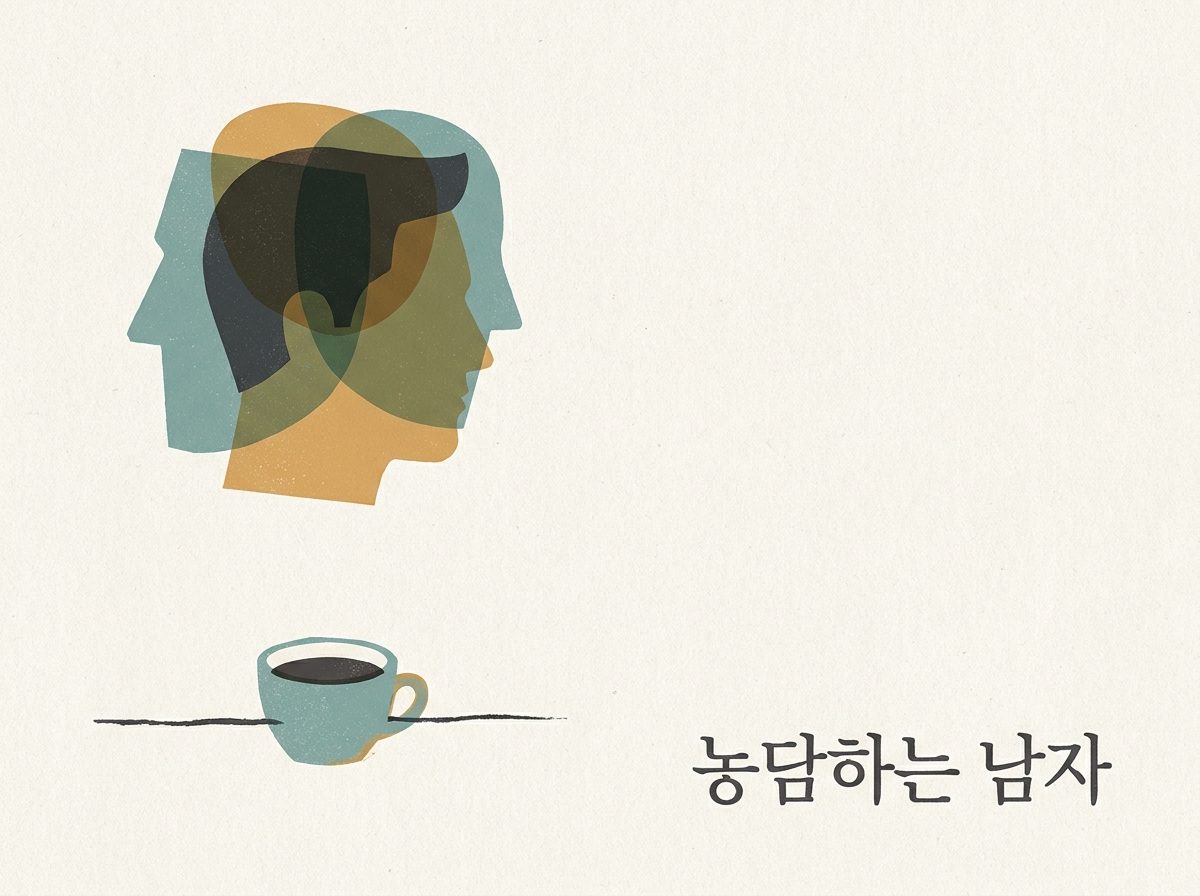
After I close the clinic door, I sometimes put on an old sitcom I used to watch without a thought in my head. Close to midnight, one can of beer, six people talking in an American apartment from twenty or thirty years ago. It means nothing in particular. I only want to blunt the edge of the day.
That night, though, one man kept catching my eye. Chandler Bing. He does something vaguely like accounting, though no one knows exactly what, and the moment the mood threatens to turn even slightly serious he throws out a joke, without fail. A friend, close to tears, opens up to him, and he answers with a quip. People laugh. And the serious moment scatters, just like that.
At first it was simply funny. The second time through, it seemed a little strange. By the third, I had set my beer down and was watching the man with a professional eye. He is running from something, right now.
So for a few days I decided to take out the lenses I own, one at a time, and hold each of them up to him.
The First Lens — What the Joke Is Holding Back
What would Freud have called this?
He was a man who took jokes rather seriously. He separated jokes from the comic and from humour, and worked out where each one draws its pleasure from. Of all of it, what he said about humour stays with me longest. Humour, he said, is what moves in to occupy the place where a painful feeling would have come. In a situation that ought to call up fear or anger or despair, it saves the energy that the feeling would have used to rise.
Put simply: if you make a joke in the place where you should grieve, the strength you would have spent on grief never has to come out. The strength you saved bursts out as laughter. When Chandler jokes in front of a friend’s tears, he is not comforting the friend. He is cutting off, in advance, the feeling that is trying to rise inside himself. The joke is a shield.
It is after this that Freud says the frightening thing. He placed humour at the top of all the defences a human being has. Unlike repression, which forces pain out of consciousness, humour looks straight at the pain and slips only the feeling out of it. That is why it is lofty. But in the same breath he wrote this: humour belongs to the series of methods human beings have devised to escape the compulsion to suffer, a series that begins with neurosis and culminates in madness.
The man who jokes, then, is standing somewhere near the entrance to that series.
The Second Lens — The Mask and the Person Behind It
I look at the same scene again, through Jung’s eyes.
Jung has a concept called the persona. The Latin word for an actor’s mask. It is the face we wear when we go out into society. Jung called the persona a kind of compromise struck between the individual and society. On one side it gives others a certain impression; on the other it hides one’s real nature. The trouble is not the mask itself. There is no one who does not need a mask. The trouble begins when a person comes to believe that he and his mask are the same thing.
Chandler’s mask is “the witty one.” The man who has a line to throw back in any situation. That is his social face, and he lives in that face alone. When this kind of identification happens, Jung said, real individuality falls into the unconscious, and the person becomes the very role he is playing. And then he uses a rather harsh expression. Lift that husk, he says, and underneath there is only a very pitiable little creature.
Behind the wit, a pitiable little creature. The real face of Chandler that the sitcom lets slip now and then is exactly that. A man who runs from love, who breaks things first for fear of being left, who dreads above all else being left alone. The more dazzling the mask, the emptier what lies behind it.
The Third Lens — A Borrowed Function
From here on I have to speak in the language of my own field. I am a doctor of Korean medicine, and I study Sasang medicine. Within it, I look into a branch called Sasang mind-study (四象心學), which reads the way a person uses the mind through constitution.
Sasang mind-study has a concept called functional borrowing. A person is born with a superior function, but when for some reason he cannot use it properly, he forcibly drags in a weaker function and makes it his mainstay. He lives against his own nature. Sasang mind-study calls it contrary movement (逆動, yeokdong) when the energy of a yin-type person surges upward. It means the flow is not a natural one.
If I were to set Chandler on this frame anyway—strictly as a thought experiment—he looks like a man who is by nature a deep thinker, but who, instead of meeting a situation with that deep thought, has hardened into reaching for the emotional wit that springs out on the spot. Sasang mind-study says that when a weak function is forced into the role of mainstay like this, the strain and depletion of the mind grow heavy, and in the end it reaches as far as disharmony in the body.
What weighs on me more is a word: talsim (奪心), the seizing mind. The mind that, instead of thinking hard about something new until it reaches a right judgment, hurries to close the judgment with a “that’s roughly what it is.” Chandler’s wit is exactly that. Each time he should go deep, he shuts the situation with a quick line. The fatigue of a man who lives on a borrowed function lies spread beneath those light jokes.

The Fourth Lens — The One Thing He Could Not Cut
Last, I go down to the deepest place. The eye of Buddhism.
In the Madhyama Āgama (中阿含經, Jung-aham-gyeong) there is a short sutra called the Lion’s Roar (師子吼經, Saja-hu-gyeong). In it the Buddha speaks of four kinds of clinging. Clinging to sensual desire, clinging to rules, clinging to views, and clinging to self. What are commonly called the four clingings. The sutra says something interesting. One who speaks of cutting the first three but says nothing of cutting the last, clinging to self, has in fact cut nothing properly at all. And the root of all four clingings, it says, is one thing: ignorance, which is to say darkness.
I think of what Chandler craves without end. He wants to be recognized, wants to be funny, wants to be loved, and all the while he pushes every one of these away with his own hands. He is not filled. He cannot be filled. Through the eye of Buddhism, he is only chasing desire from one object to the next, and has never once touched the nail on which all that craving hangs, the thing called “I.” He can soothe desire with jokes and soothe loneliness with relationships, but as long as the clinging to self beneath them stays where it is, the thirst comes back. Just as the sutra says: because he could not cut the one thing that matters most.
Where the Four Lenses Meet, and Where They Part
After I had held up the four lenses one by one, the same picture, strangely, rose overlapping.
Freud said he escapes pain with jokes. Jung said he hides his real self behind a mask. Sasang mind-study said he dodges deep thought with a borrowed function. Buddhism said he repeats his craving because he cannot cut the “I.” The languages differ, but the fingertips all point to one place. Chandler has spent his whole life going around a detour so as not to face something head-on.
And the four traditions point to an exit that is much the same, too. Do not run; stop once and look at it. Every day, a little at a time, without running. Whether you call it awakening or recovery, that door opens not at the moment you declare “that’s enough now,” but only in the place where you polish yourself again every day.
But exactly one of them steps aside here. Jung.
Jung knew the practices of the East well and thought highly of them. And yet he warned, firmly, that for Westerners to follow those methods to the letter was a pitiable imitation, a tragedy. Since Easterners and Westerners stand on different psychological ground, he held, a Westerner who copies that path—evening the breath each day, gathering the mind to a single point—may instead see his mind split or swell. In its place he cut a road of his own. Simply letting the fantasies arise. Action through non-action.
Here a crack opens. While the other three lenses gather toward “polish yourself every day,” Jung alone says, “that very way of polishing every day may be dangerous for you.” Looking at the same man, the four traditions do not, in the end, speak with one voice. Perhaps that is the honest ending. Seeing a person through four lenses does not tidy him into a single neat sentence. Chandler, in the end, does not reduce to any one lens.
The Living Room at Midnight, Again
On the screen Chandler is still joking. When a friend turns serious he answers with a line, people laugh, and the deep moment slips past once more. He does not know. What he is running from, or who stands behind his mask.
I finish my beer and switch off the television. The truth is, all the while I was analysing him, he did not feel like a stranger. I know the version of me who, when something serious seems about to come up in the consulting room, eases the air with a quiet joke. Everyone carries a joking man of their own around inside them.
Looking through four lenses does not make that man disappear. You only come to know that he is there. Perhaps that is enough. Before I turn out the light, I quietly count the jokes I threw out today.